
You wake up tired, even after a full night in bed. Your hands tingle when you type. You walk into a room and forget why you went there. And every time you mention it, someone says, “You are probably just stressed.”
Maybe you are. But maybe something else is going on.
Vitamin B12 deficiency is one of those conditions that hides in plain sight. Its early signs look like ordinary tiredness, a busy life or just getting older, so many people live with it for months or even years without knowing.
The good news is that vitamin B12 deficiency is easy to check with a simple blood test and, in most cases, very treatable. The better news is that once you know what to look for, you can catch it early.
In this guide, we will explain what vitamin B12 does, walk through eight warning signs worth noticing, look at who is most at risk, and cover the foods and treatments that help. Let’s get started.
So, What Is Vitamin B12 and Why Does Your Body Need It?
Vitamin B12, also called cobalamin, is a water soluble vitamin that your body cannot make on its own. You have to get it from food or supplements.
It quietly handles some of your body’s most important jobs:
- It helps make healthy red blood cells, which carry oxygen around your body.
- It keeps your nerves and brain working properly.
- It helps your body make DNA, the genetic material in every cell.
Here is something interesting. Your liver can store a surprising amount of B12, enough to last for years. That is why a shortage rarely appears overnight. It builds up slowly, month after month, until the stores run low.
Adults need about 2.4 micrograms of vitamin B12 a day. That is a tiny amount, yet missing it for long enough can cause real trouble.
Think of B12 as the electrician in your body’s house. You rarely notice it when everything works. But when the wiring starts to fail, lights flicker in several rooms at once: energy, mood, memory, balance and blood. That is exactly why vitamin B12 deficiency can look so confusing from the outside.
8 Warning Signs of Vitamin B12 Deficiency You Should Never Ignore
Not every person has every sign, and mild cases may cause no symptoms at all. But these eight are the ones doctors see most often.
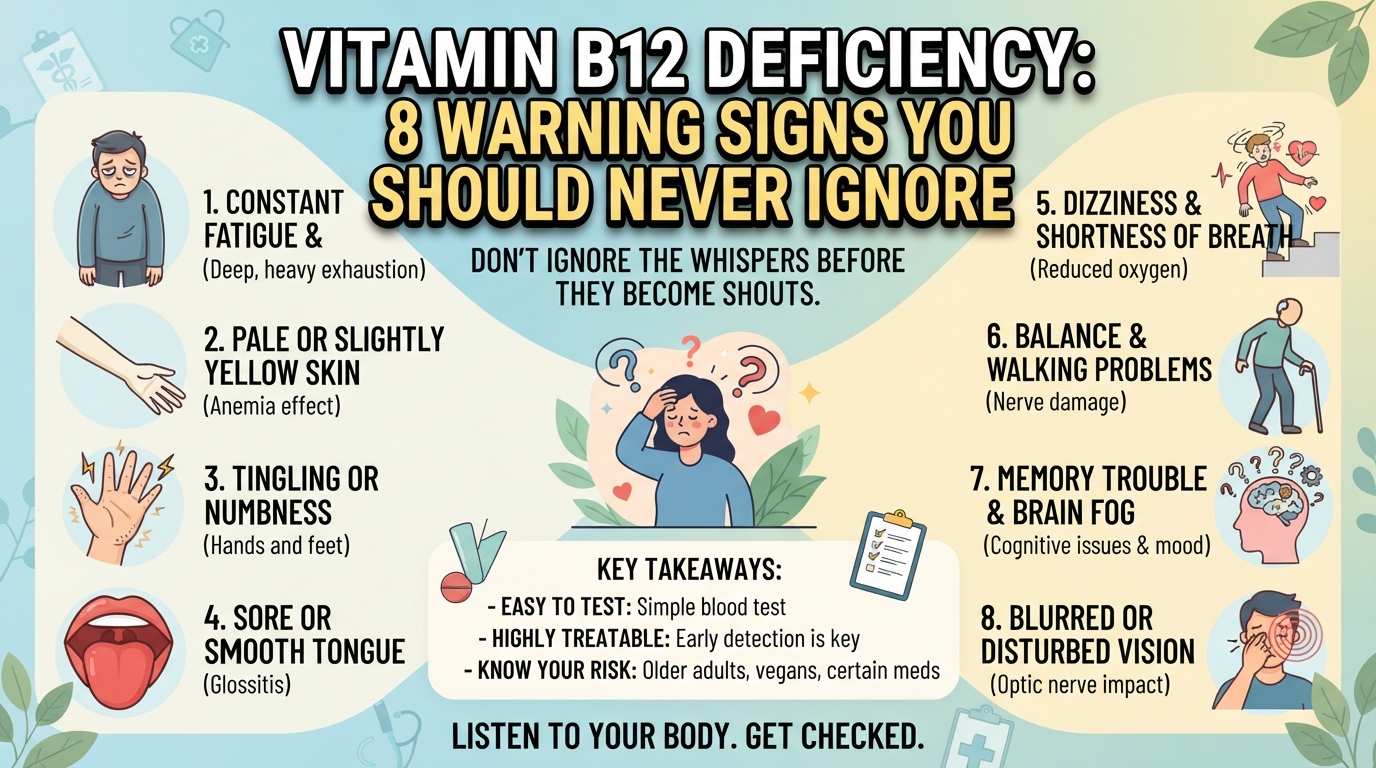
1. Constant tiredness and weakness. Low B12 can lead to a type of anemia, which means your blood carries less oxygen. The result is a deep, heavy fatigue that sleep does not fix.
2. Pale or slightly yellow skin. When red blood cells are not made properly, your skin may look pale or take on a faint yellow tint.
3. Tingling or numbness in hands and feet. Many people describe it as pins and needles. It happens because B12 protects your nerves.
4. A sore, red or smooth tongue. Some people notice a swollen, painful tongue or mouth ulcers. Doctors call this glossitis.
5. Dizziness, breathlessness and a racing heart. When your body lacks oxygen, simple things like climbing stairs can leave you out of breath.
6. Problems with balance and walking. Nerve damage can make you feel unsteady, clumsy or uncoordinated.
7. Memory trouble, brain fog and mood changes. Forgetfulness, confusion, low mood and irritability can all appear when B12 runs low.
8. Blurred or disturbed vision. In some cases, a lack of B12 affects the optic nerve, leading to vision problems.
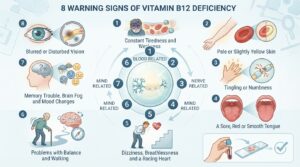
A quick way to think about it: the signs fall into three groups. Blood related signs include tiredness, pale skin and breathlessness. Nerve related signs include tingling, numbness, balance trouble and vision changes. Mind related signs include memory problems and mood changes. Having symptoms from more than one group is a strong reason to get checked for vitamin B12 deficiency.
None of these signs proves you have a problem. Many of them overlap with other conditions. But if you notice several of them, and they have lasted for weeks, a simple blood test can give you answers.
Why Vitamin B12 Deficiency Creeps Up So Quietly
If it causes so many symptoms, why does it often go unnoticed?
Because it develops slowly. Your body’s stores buy you time, so by the time symptoms appear, the shortage may have been building for a long while.
And the early signs are easy to explain away:
- Tiredness is blamed on work, kids or poor sleep.
- Forgetfulness is blamed on age.
- Tingling is blamed on sitting in an awkward position.
- Low mood is blamed on a rough patch.
Vitamin B12 deficiency also tends to be mild at first, which makes it even easier to overlook. A person may feel only slightly off for a long time, then notice a sudden drop as the stores run out.
That is why it pays to take repeated symptoms seriously. One tired afternoon means little. Months of unexplained fatigue plus tingling hands deserve attention.
Who Is Most at Risk of Vitamin B12 Deficiency?
Anyone can develop it, but some groups face a higher risk.
The National Institutes of Health reports that vitamin B12 deficiency affects somewhere between 3 percent and 43 percent of older adults (source). nih
That wide range shows how often it can go unrecognized. Besides older adults, you may be at higher risk if you:
- Follow a vegan or strict vegetarian diet, since B12 occurs naturally in animal foods.
- Have had weight loss surgery or stomach or bowel surgery.
- Live with conditions such as celiac disease or Crohn’s disease.
- Take the diabetes medicine metformin for a long time.
- Use acid reducing medicines, such as proton pump inhibitors, for years.
- Drink heavily on a regular basis.
- Are pregnant or breastfeeding without enough B12 in your diet.
If you recognize yourself in this list, it does not mean you are deficient. It means a check up is worth considering.
Older adults deserve special mention. As we age, the stomach often makes less acid, and that acid is needed to release B12 from food. This is why people over 50 are encouraged to rely on fortified foods or supplements, which the body absorbs more easily. For this age group, vitamin B12 deficiency is one of the most common and most overlooked nutrition problems.
The Hidden Causes Behind Low B12
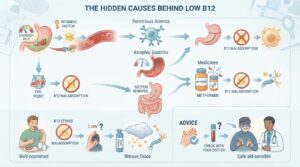
Eating too little B12 is only one reason. For many people, the real problem is absorption.
To absorb B12 from food, your body needs enough stomach acid and a protein called intrinsic factor. When something interferes with that process, B12 passes through without being used.
Common causes include:
- Pernicious anemia. An autoimmune condition in which the body cannot make intrinsic factor.
- Atrophic gastritis. Thinning of the stomach lining, more common as people age, which lowers stomach acid.
- Surgery. Removing part of the stomach or small intestine reduces absorption.
- Medicines. Long term metformin and acid reducers can lower B12 levels.
- Nitrous oxide. Frequent use of this gas, also known as laughing gas, can inactivate B12 and cause nerve damage.
This is why a person who eats plenty of meat and dairy can still develop vitamin B12 deficiency. What you absorb matters as much as what you eat.
If you take metformin or an acid reducing medicine, please do not stop it on your own. These medicines are valuable for many people. The sensible step is to ask your doctor whether your B12 level should be checked now and then.
How Doctors Check for Vitamin B12 Deficiency
The good news is that finding out is simple. A doctor will usually start with a blood test that measures your B12 level, often alongside a complete blood count to look for anemia.
If the result is borderline, additional tests can help. These may include methylmalonic acid or homocysteine levels, which rise when B12 is low. If pernicious anemia is suspected, your doctor may also check for specific antibodies.
Results are usually grouped into low, borderline and normal. A clearly low level points to vitamin B12 deficiency, while a borderline level often needs more tests to be sure. Your doctor will also try to find out why the level is low, because treating the cause matters as much as replacing the vitamin.
Please do not diagnose yourself from a symptom list. The signs above overlap with thyroid problems, iron deficiency, diabetes and stress. A proper test is the only way to know.
Why Ignoring It Can Cost You Dearly
A mild shortage may do little harm in the short term. But leaving a real deficiency untreated is a gamble.
- Anemia can worsen, leaving you weaker and more breathless.
- Nerve damage can become permanent. The longer the problem continues, the greater the chance that some nerve symptoms will not fully recover.
- Thinking and mood can suffer, with problems such as memory loss, confusion and depression.
- Pregnancy is a special case. Low B12 during pregnancy and breastfeeding can affect a baby’s development, so pregnant women should talk to a doctor.
Untreated vitamin B12 deficiency is not a minor issue, and the cost grows quietly with time. The earlier it is caught, the more fully the body tends to recover.
One important caution. Taking folic acid alone may improve the anemia while the nerve damage keeps progressing. That is another reason to get tested properly instead of guessing.
Can Low B12 Affect Your Mood and Memory?
Yes, and this part surprises many people. B12 supports the nervous system, so a shortage can show up as low mood, irritability, poor concentration and forgetfulness.
In older adults, vitamin B12 deficiency can even resemble early dementia, which is one reason doctors often check B12 when memory problems appear.
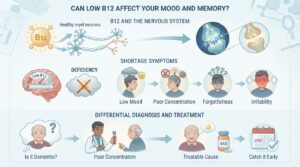
That does not mean B12 fixes every mood or memory problem, because depression and memory loss have many causes. But if low B12 is part of the picture, treating it is a simple and important step. Catching vitamin B12 deficiency early is far better than assuming that confusion is just part of getting older.
How Much Vitamin B12 Do You Need?
The amounts are small, but they matter, and meeting them is the simplest way to prevent vitamin B12 deficiency. Here are the recommended daily intakes for adults:
- Adults and teens (14 years and older): 2.4 micrograms.
- During pregnancy: 2.6 micrograms.
- While breastfeeding: 2.8 micrograms.
Most people who eat animal foods reach this level without much effort. People over 50 are advised to get most of their B12 from fortified foods or supplements, because the form in supplements is easier for the body to absorb.
Best Food Sources of Vitamin B12
If you eat animal products, you have plenty of options:
- Shellfish and organ meats: clams and beef liver are among the richest sources.
- Fish: salmon, trout, sardines and tuna.
- Meat and poultry: beef, lamb and chicken.
- Eggs.
- Dairy: milk, yogurt and cheese.
If you eat little or no animal food, you will need another plan. Natural plant foods are not a reliable source of B12. Look for:
- Fortified breakfast cereals.
- Fortified plant milks.
- Nutritional yeast products that are fortified with B12.
Even a modest serving of fish, eggs or dairy can go a long way, because the daily need is so small. A serving of salmon or trout, for example, can cover more than a full day’s requirement.
Check the nutrition label to confirm the B12 content. And if you follow a vegan diet, speak with your doctor or a dietitian about a supplement, because food alone may not be enough.
Vitamin B12 Deficiency on a Plant Based Diet: A Practical Plan
Eating plant based is a healthy choice for many people, but it needs one extra step. Because natural plant foods do not supply B12 reliably, vegans face a higher risk of vitamin B12 deficiency unless they plan ahead.
A simple plan:
- Use a daily B12 supplement or fortified foods, as advised by your doctor or dietitian.
- Get your level checked once a year, or as advised.
- Do not depend on seaweed or fermented foods as your main source.
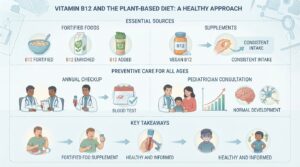
Parents raising children on plant based diets should speak with a pediatrician, because vitamin B12 deficiency in young children can affect growth and development.
Treatment: Pills, Shots and What to Expect
Treatment depends on the cause and the severity.
For many people, high dose B12 tablets are enough. Others, especially those with severe symptoms or absorption problems such as pernicious anemia, may need injections at first. Some people need treatment for life if the cause cannot be removed.
What can you expect?
- Energy and mood often start to improve within days to weeks.
- Nerve symptoms may take months to improve, and sometimes they do not fully disappear.
- Regular follow up blood tests show whether treatment is working.
Treating vitamin B12 deficiency is rarely complicated, but it does need follow through. Taking tablets for a week and stopping is not enough. Your doctor will tell you how long to continue and when to retest.
Please do not stock up on supplements without testing. A supplement will not help much if your levels are already normal, and it can hide the real cause of your symptoms.
3 Vitamin B12 Myths That Need to Go
Myth 1: Only vegans get vitamin B12 deficiency. Not true. Older adults, people with digestive conditions and those taking certain medicines are also at risk.
Myth 2: A B12 shot gives everyone an instant energy boost. B12 helps if you have vitamin B12 deficiency. If your levels are already normal, extra B12 is unlikely to make you feel more energetic.
Myth 3: Eating meat guarantees you are safe. Absorption problems can cause a shortage even when your diet is full of B12.
A Simple B12 Friendly Day on a Plate
Here is what a day might look like for someone who eats animal foods:
- Breakfast: Fortified cereal with milk, or eggs on toast.
- Lunch: A tuna or chicken sandwich with salad.
- Snack: A bowl of yogurt.
- Dinner: Baked salmon or trout with vegetables and rice.
And for someone eating plant based:
- Breakfast: Fortified cereal with fortified plant milk.
- Lunch: Lentil soup with a slice of bread.
- Snack: Fruit and nuts.
- Dinner: Vegetable curry with rice, plus a supplement recommended by a doctor.
6 Everyday Habits to Protect Your B12 Levels
Prevention is simple, and a few small habits go a long way:
- Include a B12 source in most meals, such as eggs, dairy, fish or fortified foods.
- If you are vegan, take a supplement or use fortified foods every day.
- Keep heavy alcohol use in check, since it can affect absorption.
- Ask for an occasional B12 check if you take metformin or acid reducing medicines long term.
- Treat digestive conditions properly, because they interfere with absorption.
- Do not ignore symptoms that last more than a few weeks.
If pernicious anemia runs in your family, tell your doctor. Knowing your risk of vitamin B12 deficiency early makes it much easier to stay ahead of it.
When It Is Time to See a Doctor
Book an appointment if you notice persistent tiredness, tingling or numbness, balance problems, memory changes or a sore tongue, especially if you belong to a higher risk group.
Seek prompt medical care if you experience trouble walking, noticeable confusion or vision changes, because nerve problems are best treated early.
If you already know you have vitamin B12 deficiency, keep your follow up appointments, even after you start feeling better. Feeling better is a good sign, but only a blood test shows whether your levels have truly recovered.
This article is for general information and does not replace personal medical advice.
Quick Answers to Common Questions
How long does it take to develop vitamin B12 deficiency? It often takes a long time, because the body stores B12. In people who absorb poorly, it can happen faster.
Can it be reversed? Anemia and many symptoms often improve with treatment. Nerve damage is more likely to recover if treated early.
Can stress cause vitamin B12 deficiency? Stress alone does not cause it, but it can make symptoms like tiredness and poor focus feel worse. If symptoms do not improve, get tested instead of assuming it is stress.
Is too much B12 harmful? No upper limit has been set because B12 has a low risk of toxicity, but it is still best to follow your doctor’s advice.
Final Thoughts: Listen to Your Body Before It Starts Shouting
Vitamin B12 deficiency can be sneaky, but it is also one of the easiest nutritional problems to spot and fix once you know what to look for.
If you have been feeling tired, tingly or forgetful for weeks, do not brush it off. A quick blood test could explain a lot.
And if you are in a higher risk group, such as vegans, older adults or people on certain long term medicines, make B12 part of your regular check ups.
Your body gives you signals for a reason. Pay attention to them early, and do not wait for tingling hands or foggy thinking to become your normal. Spotting vitamin B12 deficiency in its early stages gives you the best chance of a full recovery.



