
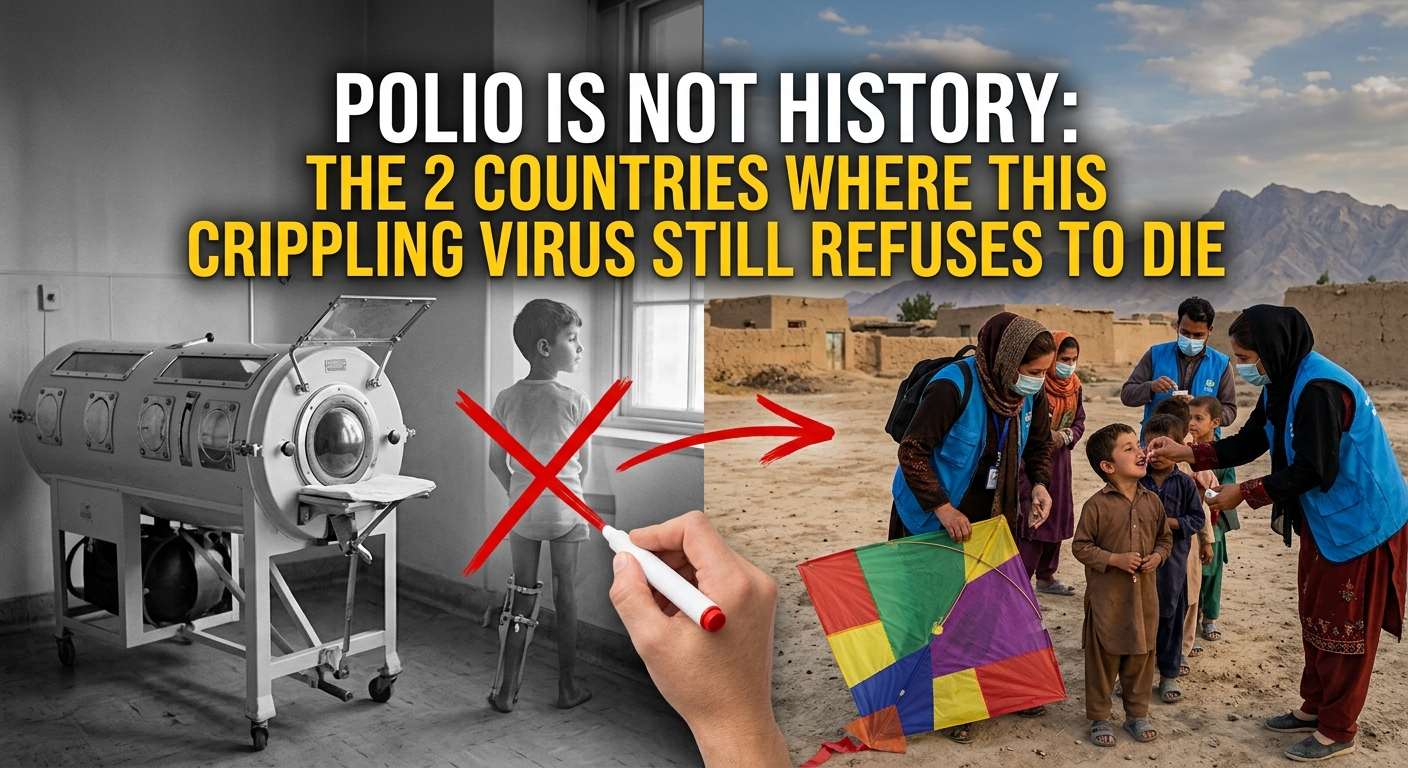
Imagine a four year old boy running after a kite on a warm afternoon. He laughs, trips, gets up and runs again. Two weeks later he has a fever, a stiff neck and a leg that suddenly refuses to hold him up.
It sounds like a scene from an old black and white movie. Yet this is how polio has changed children’s lives for generations, and in a few corners of the world it still does.
Here is the part that surprises many readers. Polio is not a disease of the past. It is a disease that the world has almost, but not quite, erased.
Today, Pakistan and Afghanistan are the only 2 countries where the wild virus is still considered endemic. That sounds small. But as long as even one child carries the virus, children everywhere remain at risk.
In this blog, you will learn how polio spreads, which warning signs matter, why the final stretch is so difficult and what every family can do. Clear facts, honest answers and no scary jargon.
Let us begin with a quick look at how far the world has come.
From 350,000 Cases to a Handful: The Race Nobody Talks About
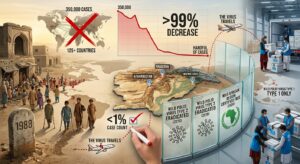
In 1988, the world launched a global mission to end polio. At that time, an estimated 350,000 people, mostly children, were paralysed every year across more than 125 countries.
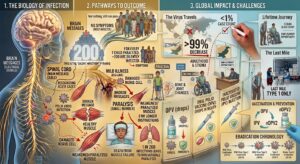
Since then, cases have fallen by more than 99 percent. That is one of the greatest public health wins in history.
Some milestones worth knowing:
- Wild virus type 2 was declared eradicated in 2015
- Wild virus type 3 was declared eradicated in 2019
- The WHO African Region was certified free of the wild virus in 2020
- Only wild virus type 1 remains
But a tiny number of cases is still a big problem, because this virus travels. One infected person can carry it across borders without anyone noticing.
That is why polio is unfinished business, not history.
Summers of Fear: When Parents Dreaded the Warm Months
Before polio vaccines existed, summer was the season many parents feared most. Outbreaks often peaked in the warm months, and families kept children away from crowds, swimming pools and cinemas.
In 1916, a major outbreak in the United States caused around 27,000 paralytic cases and about 6,000 deaths. In 1952, the country recorded close to 58,000 cases, one of its worst years.
Hospital wards filled with children lying in iron lungs, large metal chambers that helped them breathe when their chest muscles failed.
Then came the vaccines, and the story slowly changed.
Polio Explained Without the Medical Jargon
Polio is a highly infectious disease caused by a virus. It mainly affects children under 5, though anyone who is not protected can catch it.
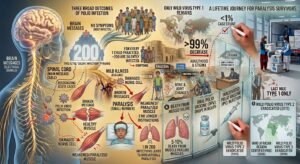
Think of your spinal cord as a main cable carrying messages from the brain to your muscles. In severe cases, the virus damages the nerve cells that send those messages. The muscles stop receiving instructions, become weak and can no longer move.
The scary truth is that infection does not look the same in everyone. There are three broad outcomes:
- No symptoms: Most infected people feel nothing at all, yet they can still pass the virus on
- Mild illness: Some have flu like symptoms such as fever, tiredness, headache, vomiting and sore throat, which pass after a few days
- Paralysis: A small number develop weakness or paralysis, usually in the legs, which is often permanent
According to the World Health Organization, 1 in 200 infections leads to irreversible paralysis.
Among those who are paralysed, 5 to 10 percent die when the muscles that help them breathe stop working.
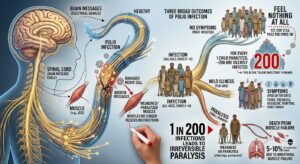
And because most infections are silent, for every child who is paralysed, there may be around 200 others who are infected without any sign at all. That is the real reason the title of this blog talks about a virus that refuses to die.
How a Tiny Virus Travels From One Child to Another
The virus spreads from person to person. It usually enters through the mouth, often through hands, food or water contaminated with the stool of an infected person.
Once inside, it multiplies in the throat and gut. In a small number of people, it then reaches the nervous system and attacks the nerve cells that control muscles.
It spreads most easily in places such as:
- Crowded neighbourhoods with poor sanitation
- Communities without clean drinking water
- Areas where many children have missed vaccine doses
- Homes where hand washing is not a daily routine
An infected person can spread the virus for several weeks, even while feeling completely fine. That is what makes polio so sneaky.
6 Warning Signs You Should Never Ignore
Remember that most infections cause no symptoms, and many early signs look like a common cold or stomach bug. That is why they are so easy to miss.
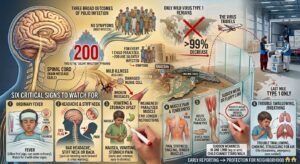
Here are six signs to watch for, especially in an unvaccinated child. None of them proves polio on its own. But a sudden weak limb is always a medical emergency.
Sign 1: A Fever That Seems Ordinary
Fever is often the first sign. It may come with a sore throat and tiredness, so most families assume it is just a seasonal bug.
Fever alone is common and rarely means polio. It matters more when it shows up together with other signs on this list.
Sign 2: Headache and a Stiff Neck
A bad headache with a stiff neck or back can happen when the virus irritates the lining around the brain and spinal cord. Pain when bending the neck forward is a red flag.
Sign 3: Vomiting and Stomach Upset
Nausea, vomiting and stomach pain can appear early. Because these are so common in children, this sign is often brushed off.
Sign 4: Pain, Tingling and Tender Muscles
Many people feel pain, stiffness or tingling in the limbs and back. The muscles may feel tender, and even a gentle touch can cause discomfort.
Sign 5: A Sudden Weak or Floppy Limb
This is the classic warning. One leg, or sometimes an arm, becomes loose and floppy within hours or days, often on one side only. Doctors call it acute flaccid paralysis.
A child may suddenly refuse to stand, walk or put weight on a leg. Report any sudden weakness to a doctor immediately.
Sign 6: Trouble Swallowing or Breathing
When the virus affects the muscles used for swallowing and breathing, a person may cough, choke or struggle for air. This is life threatening and needs emergency care.
If a child suddenly cannot move a limb, do not wait to see if it gets better. Go to a doctor or hospital at once. Early reporting also helps protect the whole neighbourhood.
Who Is Most at Risk?
Anyone who is not fully vaccinated can catch the virus. But some groups face a higher risk:
- Children under 5, especially those who missed doses
- Babies and toddlers living in crowded homes with poor sanitation
- People living in areas with low vaccine coverage
- Unvaccinated travellers heading to places where the virus still circulates
Polio does not care about status or background. It only needs an unprotected child and an opportunity.
How Doctors Confirm What Is Going On
Doctors suspect polio when a child suddenly develops a weak or floppy limb. But sudden weakness can have other causes, so tests are needed.
Doctors usually:
- Examine the child and ask about vaccination history
- Collect stool samples, which are tested in a laboratory for the virus
- Sometimes test throat swabs or spinal fluid
Testing matters for two reasons. It confirms the diagnosis, and it helps health teams respond quickly in the child’s neighbourhood so that others are protected.
The Long Shadow: Life After the Illness
For children who are paralysed, the story does not end when the fever goes away. Many survivors grow up facing real challenges:
- Many polio survivors live with permanent weakness, and sometimes shorter or thinner limbs
- Bone and joint changes can develop as a child grows
- Braces, crutches or wheelchairs often become part of daily life
- Stigma can mean fewer chances at school and work
- Post polio syndrome, which means new muscle weakness, tiredness and pain, can appear decades after the original illness in some survivors
The disease can steal movement in a matter of days. Its effects can last a lifetime.
Polio Vaccines: The Shield That Changed History
There is no cure for polio. Once paralysis happens, it cannot be reversed. But prevention works beautifully.
Two vaccines are used around the world:
- Oral polio vaccine (OPV): Given as drops in the mouth. It is low cost, easy to give and helps stop the virus from spreading in communities
- Inactivated polio vaccine (IPV): Given as an injection. It is highly effective at preventing paralysis
In 1955, Jonas Salk’s injectable vaccine was announced as safe and effective, and cases began to fall sharply in countries that adopted it. A few years later, Albert Sabin’s oral vaccine made mass vaccination campaigns far easier.
One dose is not enough. Children need several doses at the right ages. Your local health worker or paediatrician can tell you the exact schedule used in your country.
Vaccines also protect the community. When most children are protected, the virus has fewer places to spread.
The Rare Twist: When a Vaccine Virus Becomes a Problem
Here is something many articles skip. In very rare cases, the weakened virus used in oral polio drops can keep passing from person to person in places where few children are vaccinated.
Over time, it can change and regain the ability to cause paralysis. Experts call this vaccine derived virus.
This does not mean vaccines are the problem. It means gaps in protection are. Where most children are fully vaccinated, this almost never happens.
The answer is not fewer vaccines. It is higher coverage. Newer tools, such as the injectable vaccine and an improved oral vaccine for type 2, are helping reduce the risk even further.
The Last Mile Problem: Why the Virus Is Still Hiding
Cutting polio cases from 350,000 to a few was hard. Getting from a few to zero is harder. Here is why:
- Hard to reach children: Remote villages, mountain areas and flood hit regions are difficult to access
- Conflict and insecurity: Vaccination teams sometimes work in unsafe areas, and health workers have faced attacks in some places
- Misinformation: Rumours convince some families to refuse the drops
- Mobile families: Children who move often are easy to miss
- Weak sanitation: Contaminated water helps the virus spread
- Missed doses: Small gaps add up, leaving pockets of unprotected children
Every one of these problems has a human solution: trust, access and patience. Frontline polio workers walk door to door in heat, cold and sometimes danger. They deserve our respect.
Myths That Put Children at Risk
Myth: Polio is gone, so vaccines are no longer needed.
Truth: The virus still circulates in 2 countries and can travel. As long as it exists anywhere, unvaccinated children are at risk.
Myth: Extra drops are harmful.
Truth: Repeated doses are safe and build stronger protection. Campaign doses are given on top of routine ones for a reason.
Myth: Vaccine drops cause infertility.
Truth: There is no scientific evidence for this claim. Medical experts have examined it and found the vaccines safe.
Myth: A child with a cold, mild fever or loose motions cannot get the drops.
Truth: Minor illness is generally not a reason to skip vaccination. If you are unsure, ask your health worker.
Myth: Only poor children get polio.
Truth: Poor sanitation raises the risk, but any unprotected child can catch the virus.
What to Do If You Suspect Something Is Wrong
If you suspect polio, act quickly:
- Take the child to a doctor or hospital immediately
- Do not rely on home remedies, massage or herbal treatment to bring back movement
- Tell the health team about the child’s vaccination history
- Cooperate if they ask for a stool sample, because it helps confirm the diagnosis and protect others
There is no medicine that cures polio. But supportive care helps. It may include pain relief, physiotherapy, braces or mobility aids and, in severe cases, help with breathing. Rehabilitation can improve strength and independence, so do not lose hope.
Polio Prevention: Simple Steps Every Family Can Take
You do not need fancy equipment to protect a child. These steps make a real difference:
- Make sure every child gets all recommended vaccine doses on time
- Accept the drops during vaccination campaigns, even if your child has already been vaccinated
- Wash hands with soap after using the toilet and before eating or preparing food
- Drink safe, clean water, and boil or treat it if you are unsure
- Dispose of babies’ diapers and stools safely and keep toilets clean
- Check vaccine records before travelling to places where the virus still circulates
- Talk to a doctor if you are unsure about any dose
Small, boring habits quietly save children from polio.
Quick Answers to Questions Parents Whisper
Can adults get polio?
Yes, if they are unvaccinated. It is more common in children, but adults can be infected too, and the paralysis can be severe.
Is it contagious?
Yes. It spreads easily from person to person, including from people who have no symptoms.
Does one vaccine dose protect for life?
Usually not. Several doses are needed for strong protection, which is why schedules matter.
Can a vaccinated child still get it?
Fully vaccinated children are very well protected, though no vaccine is perfect. Keep up with every dose to stay safe.
Can a child recover fully?
Many infections cause no symptoms or only mild illness. Children who are paralysed may regain some strength with rehabilitation, but some weakness can be permanent.
Final Thoughts: The Finish Line Is Closer Than You Think
For decades, ordinary parents, nurses, doctors, volunteers and community leaders have worked together to push this disease to the edge of extinction. We are closer than ever.
The last stretch is the hardest, but it is also the most hopeful. When every child gets every dose, the virus runs out of places to hide.
Polio does not need to stay in our future. It belongs in history books, and each of us can help it get there.
If you have a child at home, check the vaccine card today. If you know a relative or neighbour who is unsure, share this blog and talk kindly. One honest conversation can protect a child.
This blog is for education only and does not replace advice from a doctor.



