
Think about the last time you walked into a room and forgot why you went there. Annoying, right? Most of us laugh it off and move on.
Now imagine that forgetting never goes away. It grows slowly and quietly, until familiar faces, favorite songs and even the road home start to fade. That is daily life for millions of families living with Alzheimer’s Disease.
Here is the part that surprises most people. By the time the first memory slip shows up, the brain has often been changing for many years. The damage starts long before the symptoms do.
In this blog, we will look at what is really happening inside the brain, the early signs worth noticing, who is at risk, what treatment can offer today, and the habits that may help protect your mind. Grab a cup of tea and stay with me. This could be one of the most useful reads for your health this year.
It Is Not Just “Getting Old”
Many people still believe that memory loss is a normal part of aging. It is not. Slowing down a little is normal. Losing the ability to manage daily life is not.
Alzheimer’s Disease is a progressive brain disorder that slowly damages memory, thinking and behavior. It is the most common cause of dementia. Dementia is the broad term for a decline in mental ability that interferes with everyday life, and Alzheimer’s Disease is one specific cause under that umbrella.
The condition is named after Dr. Alois Alzheimer, a German psychiatrist. In 1906, he described the brain of a woman named Auguste Deter, who had died after years of memory loss, confusion and unusual behavior. Under the microscope, he found strange clumps and tangled fibers in her brain tissue.
More than a hundred years later, those same two features are still the hallmarks of Alzheimer’s Disease. Let me explain what they are, because this is where the story gets really interesting.
The Deadly Silent Change Nobody Can Feel
Inside a healthy brain, billions of nerve cells pass messages to each other all day long. Picture a busy city where every road stays open and traffic keeps moving smoothly.
In Alzheimer’s Disease, two proteins go wrong:
- Amyloid beta: sticky fragments of this protein clump together into plaques that build up between nerve cells.
- Tau: this protein normally keeps nerve cells stable from the inside, but it twists into tangles that slowly choke the cell.
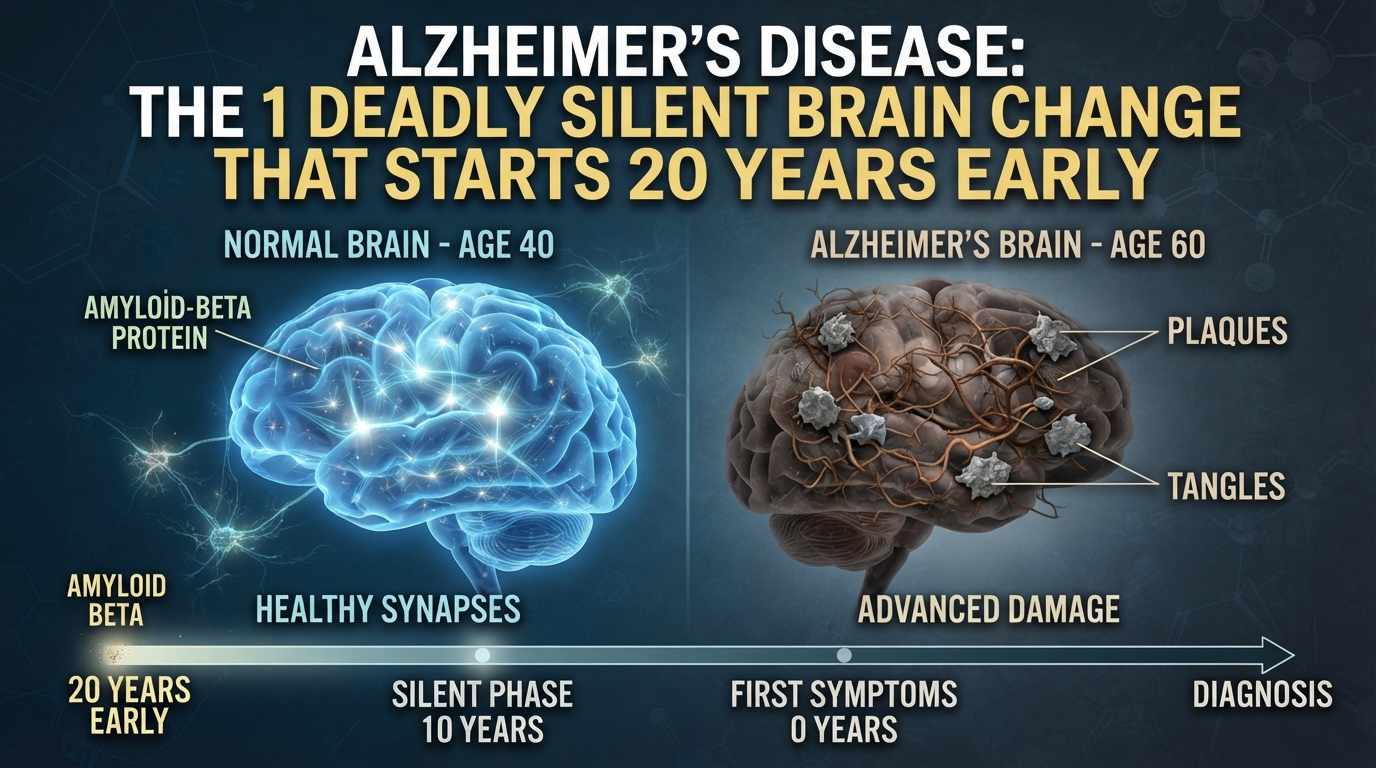
The earliest change is the quiet buildup of amyloid. Research shows this can begin 15 to 20 years, and sometimes even longer, before anyone notices a memory problem. There is no pain, no headache and no warning bell.
That is exactly what makes it so dangerous. You cannot feel it, and a routine checkup will not catch it.
As time passes, the tangles spread, connections between nerve cells break down and cells begin to die. The brain actually shrinks, especially in the hippocampus, the area that helps form new memories. That is why the first symptom is so often trouble remembering something recent.
Here is the hopeful side. Because the process starts so early, there is also a long window in which healthy choices may make a difference. We will get to those habits soon.
Six Early Signs of Alzheimer’s Disease You Should Never Brush Aside
Health organizations that study dementia describe several early warning signs. Having one of them now and then does not mean you have the disease. What matters is a pattern that keeps getting worse over weeks and months.
Let me take the six most common ones, one by one.
1. Forgetting What You Just Learned
Everyone forgets a name now and then. The concern begins when recently learned information keeps slipping away. Someone may ask the same question three times in one hour, or depend heavily on sticky notes and phone reminders for things they used to handle easily.
Because Alzheimer’s Disease usually damages the memory center first, this is often the very first sign families notice. A mother who always remembered every birthday suddenly cannot recall that her son called this morning.
2. Plans and Numbers Start to Feel Like a Puzzle
Following a recipe, paying monthly bills or tracking household expenses may suddenly feel confusing. A person who was always sharp with money may start making mistakes. Tasks that need several steps and full concentration take much longer than before.
Many families first notice this when unpaid bills start piling up on the table.
3. Lost in Time and Place
Forgetting what day it is can happen to anyone. But getting lost in a familiar neighborhood, or losing track of seasons and how much time has passed, is different. Some people forget how they reached a place or even why they went there at all.
This sign can be risky, because a person may wander and be unable to find the way back home.
4. The Right Word Just Won’t Come
We all have “tip of the tongue” moments. In early Alzheimer’s Disease, though, people may stop in the middle of a sentence with no idea how to continue, repeat themselves again and again, or call a common object by the wrong name, like calling a watch a “hand clock.”
Conversations become tiring, so many people slowly start talking less.
5. Things in Strange Places
Misplacing your keys is normal. Finding them in the freezer is not. A person with this condition may put things in unusual places and then be unable to retrace their steps to find them.
Sadly, some begin to accuse others of stealing, because they cannot understand where their things went. This hurts families deeply, so it helps to know it is the illness talking.
6. A Personality That Seems to Change in Alzheimer’s Disease
Mood and personality shifts can appear early. A calm person may become anxious, suspicious or easily upset. Others withdraw from hobbies, friends and family gatherings they once loved.
Many relatives say, “It feels like he is becoming someone else.” If you hear yourself saying that about a loved one, take it seriously.
If you notice several of these signs, do not panic and do not ignore them. Book an appointment with a doctor. Early answers always help.
Normal Forgetfulness or Something More?
This is the question every worried family asks. Here is a simple comparison:
- Normal aging: forgetting a name but remembering it later. Alzheimer’s Disease: forgetting important recent events or entire conversations.
- Normal aging: missing an occasional payment. Alzheimer’s Disease: constant trouble managing money and bills.
- Normal aging: sometimes losing the right word. Alzheimer’s Disease: frequent trouble following or joining a conversation.
- Normal aging: misplacing glasses now and then. Alzheimer’s Disease: losing things in odd places and being unable to retrace steps.
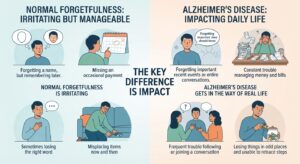
The key difference is impact. Normal forgetfulness is irritating. Alzheimer’s Disease gets in the way of real life.
A Global Problem With a Very Personal Face
Numbers can feel cold, but these ones are worth a pause. The World Health Organization estimates that more than 57 million people worldwide were living with dementia in 2021, and Alzheimer’s Disease is the most common form, making up an estimated 60 to 70 percent of cases (WHO dementia fact sheet).
Behind every one of those numbers is a daughter learning to repeat herself patiently, a husband learning to cook for the first time, or a grandchild who is slowly forgotten.
This is not only a medical issue. It is a family issue, and often a community issue too.
Myths That Make Everything Harder
Wrong beliefs delay help, so let us clear a few of them up.
- Myth: Memory loss is just part of getting old. Fact: aging can slow thinking a little, but serious memory loss is caused by disease.
- Myth: Only elderly people can get it. Fact: age is the biggest risk, but a small number of people develop symptoms before 65. This is called early onset.
- Myth: Nothing can be done. Fact: treatment, support and healthy habits can improve quality of life, and research is moving quickly.
- Myth: If a parent had it, you will definitely get it. Fact: family history raises risk, but it does not decide your future.
- Myth: Alzheimer’s Disease and dementia are the same thing. Fact: dementia is the group, and this disease is its most common member.
Who Is More Likely to Develop Alzheimer’s Disease?
No one can predict with certainty who will get Alzheimer’s Disease. But researchers have identified several factors that raise the odds:
- Age: the biggest known risk factor. Most people with the condition are 65 or older.
- Family history and genes: having a parent or sibling with the condition raises risk. A gene variant called APOE e4 is the best known genetic risk factor, though having it does not guarantee the disease.
- Heart and blood vessel health: high blood pressure, high cholesterol and diabetes all affect the brain.
- Hearing loss, depression and loneliness: these are linked with higher dementia risk.
- Head injuries: serious or repeated brain injuries can raise risk later in life.
Now here is an important point. A major 2024 report from the Lancet Commission estimated that about 45 percent of dementia cases worldwide could potentially be prevented or delayed by addressing 14 modifiable risk factors. Your genes are not your whole destiny.
How Doctors Find the Answer
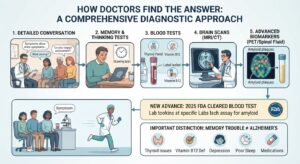
There is no single test that works for everyone, so doctors usually combine several steps:
- A detailed conversation about symptoms, often with a family member present
- Memory and thinking tests
- Blood tests to rule out other causes, such as low vitamin B12 or thyroid problems
- Brain scans like MRI or CT to check for other conditions
- In some cases, PET scans or spinal fluid tests that look for amyloid and tau
Technology is moving fast here. In 2025, the US Food and Drug Administration cleared the first blood test to help diagnose Alzheimer’s Disease in adults who already have symptoms. It is not a casual screening for everyone, but it shows where things are heading: easier and earlier detection.
Also, do not assume memory trouble always means this disease. Thyroid problems, low vitamin B12, depression, poor sleep and some medicines can look very similar. That is one more reason to see a doctor instead of guessing.
Why Finding Alzheimer’s Disease Early Changes Everything
Some people avoid the doctor because they fear the answer. I understand that. But early diagnosis gives you real advantages:
- You can start treatment for Alzheimer’s Disease when it works best
- You can rule out curable causes of memory loss
- You can plan finances, legal matters and care while the person can still share their wishes
- Families get time to prepare, learn and build a support system
Waiting does not make Alzheimer’s Disease any smaller. It only makes the decisions harder.
Questions Families Ask Most Often
Is Alzheimer’s Disease hereditary?
Not in most cases. Family history raises the risk, but most people who develop Alzheimer’s Disease have no single inherited cause. A rare early onset form is linked to specific gene changes that run in some families.
Can younger people get it?
It is uncommon, but yes. Early onset Alzheimer’s Disease can appear before the age of 65, sometimes in a person’s 40s or 50s.
Is it contagious?
No. You cannot catch Alzheimer’s Disease from another person, whether through touch, food or conversation.
How long can someone live after diagnosis?
It varies a lot. On average, people live roughly four to eight years after diagnosis, though some live much longer, even up to twenty years, depending on age, overall health and the quality of care.
Is there any benefit in doing brain games?
Mental activity is good for you, and it is fun. But no single puzzle or app can prevent Alzheimer’s Disease on its own. Think of brain games as one small part of a bigger lifestyle picture.
What Treatment Can and Cannot Do
Let me be honest and clear. There is no cure for Alzheimer’s Disease today. But that does not mean nothing can be done.
- Symptom medicines: drugs such as donepezil, rivastigmine, galantamine and memantine can help some people with memory and thinking symptoms for a period of time.
- Newer antibody treatments: lecanemab and donanemab are approved in the United States for early stage disease. They remove amyloid from the brain and can modestly slow decline in some people. They can also cause side effects such as brain swelling or small bleeds, so they need careful monitoring.
- Care and support: routines, safe surroundings, physical activity, social time and caregiver training make a big difference every single day.
The new medicines are not miracle cures, and they are not right for everyone. A specialist can explain who may benefit. Still, for the first time in decades, treatment is moving from only easing symptoms toward touching the disease process itself. That is real progress.
Nine Daily Habits That May Protect Your Brain
No habit can guarantee protection from Alzheimer’s Disease. But the evidence is strong that what is good for your heart is usually good for your brain too.
- Move your body: aim for about 150 minutes of brisk activity a week, as general health guidelines suggest.
- Control blood pressure: high blood pressure in midlife is linked with higher dementia risk.
- Eat smart: Mediterranean style and MIND style diets, rich in vegetables, berries, nuts, beans, fish and olive oil, are linked with better brain health.
- Protect your sleep: adults generally need seven to nine hours a night.
- Stay socially connected: talk, visit, join, laugh.
- Keep learning: read, take a class, learn a language, play strategy games.
- Treat hearing loss: hearing aids may help lower the extra risk linked with untreated hearing loss.
- Quit smoking and limit alcohol: both harm blood vessels and brain cells.
- Protect your head: wear a helmet and a seat belt.
A large US trial reported in 2025 found that a structured program combining exercise, diet, brain training and health monitoring improved thinking test scores in older adults at higher risk. Small steps, repeated daily, really do add up.
The best part? You can begin today, whatever your age.
A Quick Message for Readers in Their 30s and 40s
You might think this blog is only for your parents. It is for you too. The brain changes behind Alzheimer’s Disease can start decades before symptoms, so the habits you build now are the ones that count later.
Walk more. Sleep properly. Manage stress, keep your cholesterol and blood pressure checked, and protect your hearing. None of this is glamorous, but it is the foundation of a healthy brain. Think of it as a savings account for your memory, where every good habit is a small deposit for your future self.
If you ever feel your own thinking is changing in a worrying way, see a doctor early. Alzheimer’s Disease is rare at your age, but other treatable conditions are common.
The Three Stages in Simple Words
Alzheimer’s Disease usually moves through three broad stages, though every person is different:
- Early stage: mild memory lapses, trouble finding words and difficulty planning. The person can often still live independently.
- Middle stage: this is often the longest stage. Confusion grows, personality changes become clearer, sleep gets disturbed and help is needed with daily tasks.
- Late stage: the person may lose the ability to respond to their surroundings or to speak, and needs full time care.
How fast the disease moves depends on the person. Some live many years after diagnosis, others fewer.
If Someone You Love Is Affected
Caring for a person with this illness is one of the hardest jobs there is. If that is you, here are a few things that help:
- Keep a simple, steady daily routine
- Use short, gentle sentences and give one instruction at a time
- Never argue about facts. Step into their reality with kindness
- Make the home safe by removing trip hazards and locking away dangerous items
- Learn about the condition from trusted sources and local support groups
- Look after yourself too, because a tired, burned out caregiver cannot give their best
Asking for help is not weakness. It is wisdom.
Even when words fade, people often still respond to music, touch, a familiar voice and a warm smile. Never underestimate how much those small things mean.
Final Thoughts: Awareness Is Your First Medicine
Alzheimer’s Disease begins silently, years before the first lost word or forgotten name. That fact can feel frightening, but it can also be empowering. A long quiet beginning means there is time to act, to protect your brain, to notice early changes and to seek help before things get harder.
Move more. Sleep well. Stay connected. Keep your blood pressure in check. And if something about your memory, or a loved one’s memory, worries you, speak to a doctor sooner rather than later.
Alzheimer’s Disease may change what a person remembers, but it never changes their need for love, dignity and patience. Be the person who offers all three.
Disclaimer: This blog is for general awareness only and is not a substitute for professional medical advice. Please consult a qualified doctor for any health concern.



