
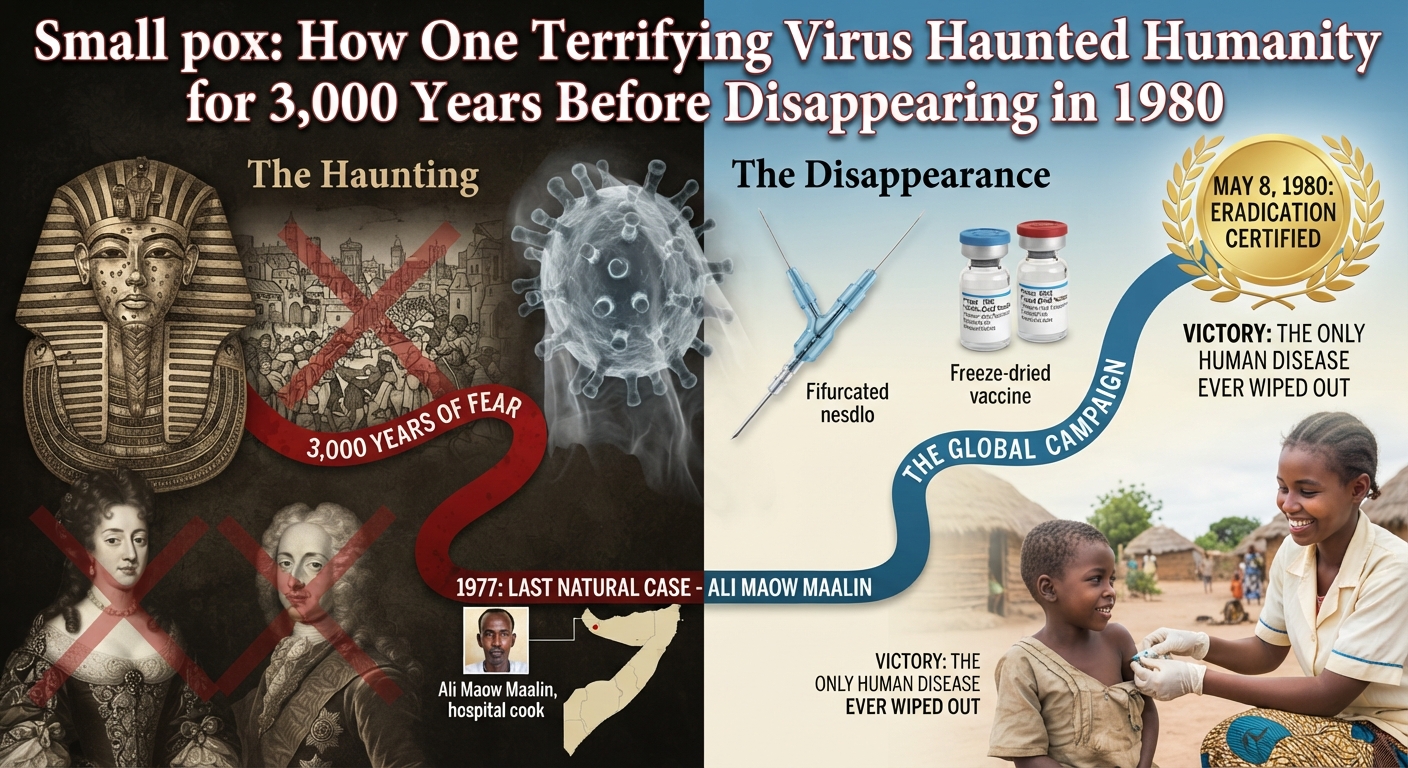
In October 1977, a young hospital cook named Ali Maow Maalin felt feverish in the port town of Merca, Somalia. He had no idea his illness was about to make history. A few days later a rash appeared, and the doctors around him realized what they were looking at. It was small pox, and Ali turned out to be the last person on Earth to catch it the natural way.
Think about that for a second. A disease that had stalked kings, farmers, soldiers and children for thousands of years ended its long run in the body of a hospital cook, in a town most people have never heard of.
This is the story of how small pox went from humanity’s greatest fear to a chapter in the history books. It’s also a story about stubborn scientists, a milkmaid, a brave 8-year-old boy and thousands of health workers who walked through villages with a needle in their hands.
Grab a cup of tea. This one is worth your time.
What Exactly Is Small Pox? Meet the Virus Behind the Nightmare
Small pox was caused by the variola virus, a member of the orthopoxvirus family. Unlike many infections, it lived only in humans. There were no animal carriers, no hidden reservoirs in the wild, and no people who carried it without showing signs. That detail matters a lot, and we’ll come back to it.
The virus traveled mostly through the air. Close face-to-face contact with a sick person was enough, especially when that person coughed or breathed nearby. Bedding, towels and clothing carrying infected material could also pass it on.
There were two main forms:
- Variola major: the severe version, which killed roughly 3 out of every 10 people who caught it
- Variola minor: a milder cousin, with a death rate of around 1 percent
Even survivors rarely walked away untouched. Most were left with deep, pitted scars, often on the face. Some lost their sight because the virus damaged their eyes.
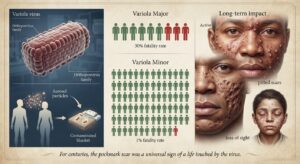
Imagine a world where almost every family knew someone with those marks. For centuries, that was simply normal life.
3,000 Years of Fear: Where Did Small Pox Come From?
Nobody can point to the day small pox first appeared. What we have are clues, and some of them are chilling.
One of the best known comes from ancient Egypt. The mummy of Pharaoh Ramses V, who died around 1157 BC, shows a skin eruption on the face that many researchers believe was small pox. Early writings from India and China also describe fevers and blisters that sound very familiar.
Here is where it gets interesting. Genetic studies of old remains, including a child mummy from 17th century Lithuania and skeletons from the Viking era, show that relatives of the virus have been around for a long time. But scientists still debate how old the modern virus really is. The figure of 3,000 years is a widely used estimate, not a settled fact.
What we do know is how deeply the disease shaped belief. In India, people prayed to Sheetala, a goddess connected with fevers and pox-like diseases. In parts of West Africa, the Yoruba honored Sopona, a deity tied to the illness.
When you can’t explain a killer, you give it a name and a temple.
Kings, Queens and Empires That Could Not Escape It
Wealth gave no protection. Queen Mary II of England died of it in 1694. Tsar Peter II of Russia died in 1730 at only 14 years old. King Louis XV of France died in 1774, and his young grandson, the future Louis XVI, was inoculated soon after.
Even Abraham Lincoln caught a mild form in November 1863, shortly after delivering the Gettysburg Address. He recovered, but the story shows that nobody was out of reach.
The Americas suffered the harshest blows. When European explorers arrived, Indigenous communities had never been exposed and had no immunity. In 1520, an outbreak tore through the Aztec capital of Tenochtitlan. It killed the emperor Cuitlahuac and weakened the city just as Spanish forces pressed their attack. Historians still debate the exact numbers lost across the continent, but they agree the toll was devastating.
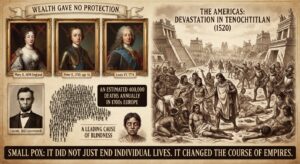
Back in Europe, the damage was steady and relentless. In the 1700s, an estimated 400,000 people died of small pox every year on that continent alone, and it was a leading cause of blindness.
Here is the big takeaway: small pox did not just end individual lives. It changed the course of empires.
From Fever to Scabs: The 6 Stages Patients Went Through
If you had caught the disease a few hundred years ago, here is roughly how the next few weeks would have gone.
- Stage 1, the silent wait: After exposure came a quiet stretch of about 7 to 19 days. No symptoms, and you were not yet contagious.
- Stage 2, the sudden crash: High fever, extreme tiredness, headache, a painful back and sometimes vomiting hit for 2 to 4 days.
- Stage 3, the first spots: Small red marks appeared on the tongue and inside the mouth, then on the face, hands and forearms.
- Stage 4, the spread: Within a day or so the rash crept onto the chest, back and legs. Flat spots turned into raised bumps.
- Stage 5, the blisters: The bumps filled with fluid and then pus. They felt firm and deep, almost like tiny beads under the skin, and they were painful.
- Stage 6, scabs and scars: After about two weeks, crusts formed. They fell off over the next few weeks, often leaving permanent scars.
A patient could spread the virus from the moment the rash appeared until the last scab dropped off. That is why entire households and neighborhoods fell sick so fast.
For a clear overview of the disease from the global health authority, see the World Health Organization page on small pox: https://www.who.int/health-topics/smallpox
Life Inside an Outbreak: Fear, Fences and Closed Doors
When small pox arrived in a town, daily life changed fast. Markets emptied. Families who could afford it left for the countryside. Those who could not stayed and hoped for the best.
Isolation was the main tool people had. Patients were kept in separate rooms or in special houses outside town, and some places marked homes with warning signs. These steps helped, but only partly. The first days looked like an ordinary fever, and by the time the rash gave the game away, others had often been exposed.
The emotional toll was just as heavy. Parents watched every child for the first sign of fever and feared small pox with every cough.
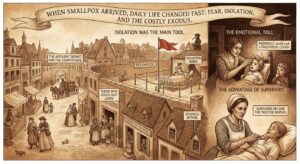
Survivors, though, had one strange advantage. Since nobody could catch small pox twice, they often became the trusted nurses of their communities.
Before the Vaccine: A Risky Gamble Called Variolation
Long before modern medicine, people noticed something useful. Anyone who survived small pox never got it again. So some communities tried giving healthy people a mild case on purpose.
The method was called variolation. Material from a patient’s sore was placed into a small cut in a healthy person’s skin. It was practiced in parts of Africa, India, China and the Ottoman Empire. It was dangerous, because some people still died and others spread the disease. But the odds were far better than catching it naturally.
In 1718, Lady Mary Wortley Montagu had her young son variolated in Constantinople. She had survived the disease herself and had lost a brother to it. Back in England in 1721, she had her daughter treated too, and she pushed the idea hard among the English elite.
That same year in Boston, the minister Cotton Mather, who had learned about the practice from an enslaved man named Onesimus, supported the physician Zabdiel Boylston in trying it during an outbreak. Boylston’s records showed only a few deaths among those he inoculated. Among people who caught the illness naturally in that outbreak, roughly one in seven died.
It was not perfect, but it was a clue that people could train their bodies to fight back.
A Milkmaid, a Country Doctor and an 8-Year-Old Boy
Enter Edward Jenner, an English country doctor. In Gloucestershire he heard a piece of local wisdom: milkmaids who caught cowpox, a mild illness from cows, seemed protected from small pox.
In May 1796, Jenner took fluid from a cowpox sore on the hand of a milkmaid named Sarah Nelmes. He scratched it into the arm of James Phipps, the 8-year-old son of his gardener. The boy had a mild illness and recovered. Weeks later, Jenner deliberately exposed him to small pox material. James did not get sick.
By today’s research standards, that experiment would never be allowed. But it proved the idea, and Jenner published his findings in 1798. The word “vaccine” comes from vacca, the Latin word for cow, a nod to where it all began.
Here is a fun twist. The virus used in later vaccines is called vaccinia, a close relative of both cowpox and variola. Where exactly it came from is still a puzzle scientists have not fully solved.
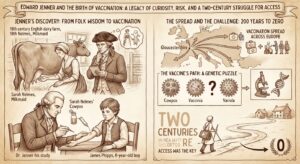
Vaccination spread across Europe and beyond within a few years. Even so, the disease kept killing for nearly two more centuries. Why? Because a vaccine only works when people can actually get it.
The Race to Zero: The Greatest Health Campaign Ever Run
By the middle of the 20th century, wealthy countries had mostly pushed small pox out of their borders. But it was still raging across parts of Asia, Africa and South America.
The idea of wiping it out worldwide was pushed in 1958 by a Soviet health official, Viktor Zhdanov, even while the United States and the Soviet Union were Cold War rivals. In 1967, the World Health Organization launched an intensified eradication program. That year, the disease was still infecting an estimated 10 to 15 million people and killing about 2 million. American physician D. A. Henderson led the effort.
Three things made the difference:
- A tougher vaccine. Freeze-dried vaccine could survive heat, so it worked in remote villages without refrigerators.
- A clever little tool. The bifurcated needle, a two-pronged needle that holds a drop of vaccine between its prongs, used less vaccine and was easy to learn. Even volunteers with short training could use it.
- Smart strategy. Instead of vaccinating everyone, teams hunted down each new case and vaccinated the people around it. This is called surveillance and containment, or ring vaccination.
Remember that detail about no animal carriers? Since the virus could only live in people, once the chain of human infection was cut, it had nowhere left to hide.
It helps to remember how hard this was. Small pox still existed in many countries at the start, and some of them were dealing with famine, floods or war at the same time. Progress was not smooth, and teams sometimes had to restart their work after setbacks.
Health workers crossed rivers, deserts, mountains and war zones. Some programs even offered rewards to people who reported a case.
The last natural case of the severe form was a 3-year-old girl named Rahima Banu in Bangladesh, in October 1975. The last natural case of any kind came two years later in Somalia, in Ali Maow Maalin, the hospital cook we met at the start. He survived. Years later he joined polio eradication campaigns himself, and he passed away in 2013.
The Last Victim: A Lab Accident in Birmingham
You would think the story ended in Somalia. It almost did, but not quite.
In 1978, Janet Parker, a medical photographer at the University of Birmingham in England, fell ill. Her workplace was just above a laboratory that was working with the virus. Investigators believed it may have traveled through the building’s air ducts, though the exact route has been debated.
She died in September 1978, becoming the last known person to die of small pox.
Her case was heartbreaking, and it changed laboratory safety rules around the world. It is also a sharp reminder that even a vanished disease like small pox can be dangerous if it is not handled with great care.
May 8, 1980: The Day the World Said Goodbye
After more than two years without a single natural case, an international commission certified in December 1979 that the disease was gone. On May 8, 1980, the World Health Assembly made it official: small pox had been eradicated.
It remains the only human disease ever wiped out through deliberate human effort. The only other disease eradicated from the planet is the cattle plague known as rinderpest, declared gone in 2011.
Think about what it took to beat small pox. Thousands of health workers from dozens of countries, many with little pay and tough conditions, walked from house to house. They did it in places with no roads, no electricity and sometimes no peace.
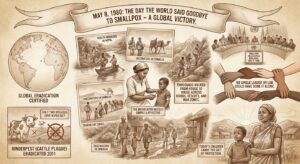
No single leader or lab could have done it alone. That is what makes this victory feel so special.
The Scar on the Arm: A Mark a Whole Generation Carries
If you have ever noticed a round, slightly sunken scar on the upper arm of an older relative, you may have been looking at a piece of history.
That mark often came from the vaccine. It was usually given by pricking the skin many times with that two-pronged needle. A small bump formed, then a blister, then a scab, and finally a scar that never fully faded.
For many families, that scar meant something simple: this person was protected. For millions, it was a quiet badge of a campaign that ended small pox as a global threat.
Today, children no longer need it. That is a gift most of us never think about.
Two Freezers, Two Countries: Is the Virus Really Gone?
Mostly gone, yes. Not entirely.
Today, WHO-approved stocks of the variola virus are kept in only two places: the Centers for Disease Control and Prevention in Atlanta, in the United States, and the VECTOR institute in Koltsovo, Russia. People have argued about their fate for decades.
- Destroy them: A lab accident or theft could, in the worst case, bring back a disaster.
- Keep them: Researchers argue they need the live virus to test vaccines and treatments.
Meanwhile, the world is better prepared than it used to be. The US Food and Drug Administration approved the antiviral tecovirimat in 2018, a vaccine called JYNNEOS in 2019, and the antiviral brincidofovir in 2021 for treating small pox.
But there is a catch. In most countries, routine vaccination stopped in the 1970s or early 1980s. That means many people alive today have never been vaccinated.
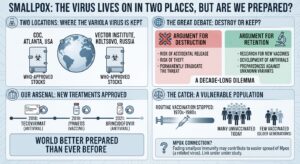
Some researchers believe fading protection may help explain why mpox, a related virus, has spread more easily in recent years. That link is still being studied, so it is best treated as a possibility rather than a proven fact.
Quick Answers to Questions People Still Ask
- Could it return from nature? Scientists consider that extremely unlikely, since the virus had no animal home to hide in. The real concern is lab safety and misuse.
- Is it the same as chickenpox? No. Chickenpox comes from the varicella-zoster virus, which is not related to the virus behind small pox.
- Is mpox the same thing? No. The two viruses are cousins, and mpox is usually milder, but the two are different diseases.
- Do I need a vaccine today? Not unless you work in certain labs or emergency response teams. The general public does not get small pox vaccination anymore.
What the World Learned From Beating a Killer
The campaign left behind lessons that health experts still talk about today.
- Good data wins. Finding every case quickly mattered more than blanket vaccination.
- Local trust matters. Teams worked with village leaders and families, not around them.
- Access beats invention. A vaccine on paper saves nobody until it reaches an arm.
- Cooperation works. Rival nations shared vaccine, money and knowledge.
These ideas still guide work against diseases like polio, measles and mpox. Every outbreak response today owes something to those barefoot health workers of the 1960s and 1970s.
Final Thoughts: Why Small Pox Still Matters Today
It is easy to read about small pox and think of it as ancient history. But its story is closer than it looks.
Within the lifetime of many people alive today, small pox was still killing millions. Then, in a surprisingly short time, humans decided together to end it, and they did.
That should give us hope. It shows what can happen when science, trust and teamwork pull in the same direction.
It also gives us a reason to stay careful. Keeping strong health systems, honest information and good lab safety is how we make sure a nightmare like this never returns.
So the next time someone says a global problem is too big to solve, remember Ali Maow Maalin and the people who stood beside him. Remember a boy named James, a milkmaid named Sarah and a doctor who trusted his curiosity.
Small pox is gone because people refused to give up. That might be the best lesson of all.



