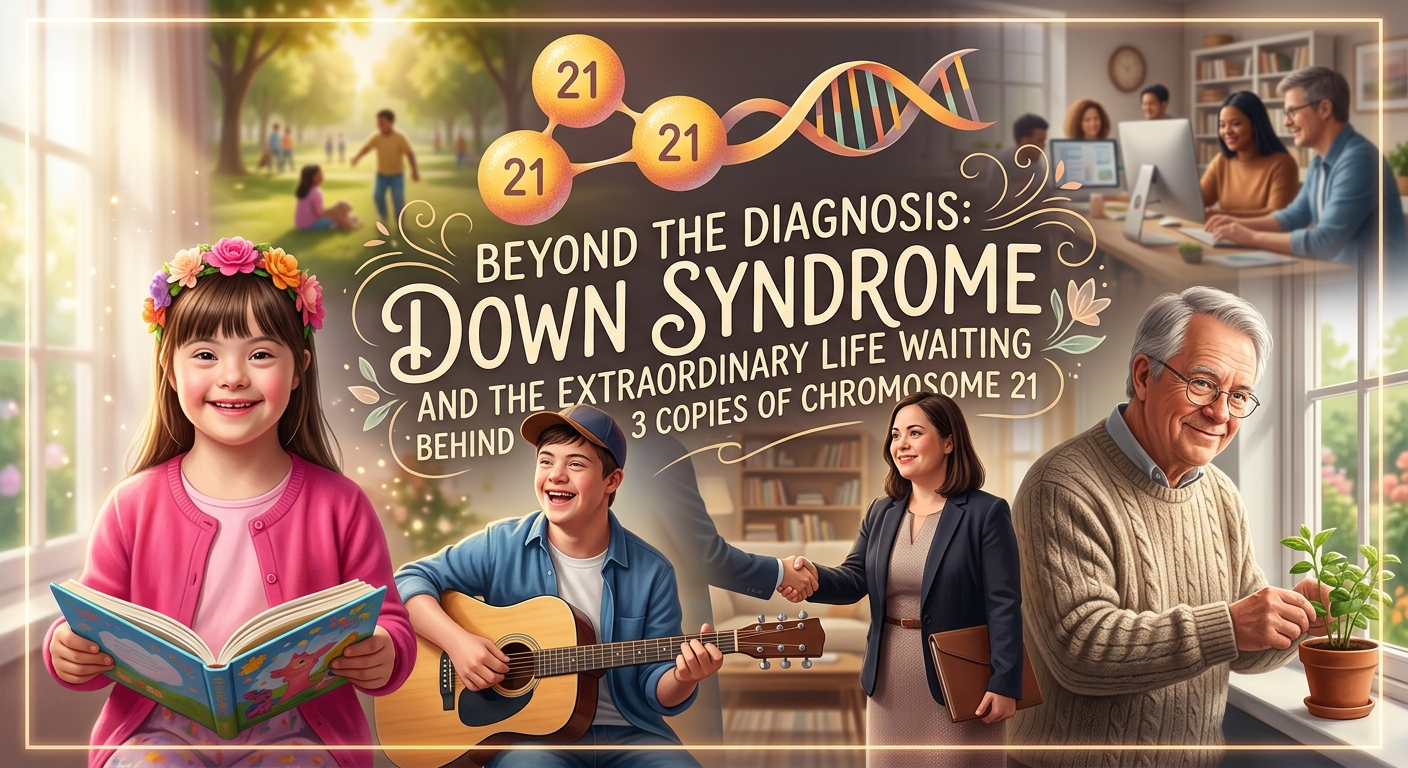
Some news arrives in a single sentence and changes the shape of a family’s future. For many parents, hearing the words Down syndrome for the first time brings a flood of questions. Is my baby healthy? What will life look like? Did I do something wrong?
If you are asking these questions, take a deep breath. You are not alone, and the story is far more hopeful than many people were ever told.
Down syndrome is not an illness and it is not a tragedy. It is a genetic difference that shapes how a person grows and learns. Behind it are real people with personalities, humour, dreams and talents, just like everyone else.
In this blog, we will look at what happens inside the body, the early signs doctors notice, the health needs to watch, the support that works and the myths that need to retire. Everything is written in plain words, so any parent, student or curious reader can follow along.
Let us start with the tiny chromosome at the centre of this story.
The Number 21: How One Tiny Chromosome Writes a Big Story
Every cell in your body carries genetic instructions packed into structures called chromosomes. Most people are born with 46 of them, arranged in 23 pairs. You inherit one set from each parent.
Down syndrome happens when a person has an extra copy of chromosome 21, either the whole chromosome or an important part of it. So instead of 2 copies, there are 3. That is why it is also called trisomy 21.
The extra genetic material changes how the body and brain develop. It affects each person differently, which is why no two people with Down syndrome are exactly alike.
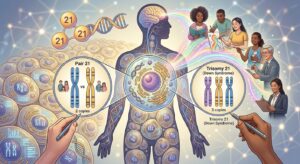
One more thing worth knowing. It is not a disease, so it cannot be caught from anyone. It cannot be cured or outgrown either. It is a lifelong part of who a person is, and the goal of support is not to change the person but to help them thrive.
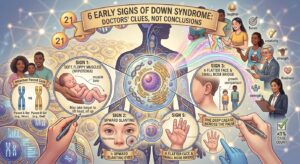
6 Early Signs of Down Syndrome Doctors May Notice
Many features can be noticed at birth. Remember, no single feature confirms anything, and many babies without Down syndrome share a few of them. Think of these as clues, not conclusions. Only a blood test can be sure.
Sign 1: Soft, Floppy Muscles
Low muscle tone, called hypotonia, is very common. A newborn may feel unusually soft when held, and may take longer to lift the head, roll over or sit up. Muscles usually get stronger with time and therapy.
Sign 2: Upward Slanting Eyes
The eyes often slant slightly upward, and there may be small folds of skin at the inner corners. Some babies also have tiny light speckles on the coloured part of the eye. These are called Brushfield spots and are harmless.
Sign 3: A Flatter Face and Small Nose Bridge
The face may look slightly flatter, especially around the bridge of the nose. The mouth can be small, and the tongue may seem a little large for it.
Sign 4: Small Ears and a Short Neck
Ears can be small or set slightly low, and the neck may look shorter than expected. As children grow, they are often a little shorter than their peers.
Sign 5: One Deep Crease Across the Palm
Most people have two creases across the palm. Some people with Down syndrome have just one deep line. Hands may also be small, with short fingers. This line also appears in other people, so it is only a clue.
Sign 6: A Gap Between the Big Toe and the Next One
Feet may show a wider space between the first and second toe. Combined with the other signs, it helps doctors decide whether to order a test.
If a doctor suspects it, they will usually explain gently and offer a test. Features also vary a lot, so a child with Down syndrome will often look much like their own family members too.
How the Diagnosis Is Confirmed
There are two kinds of tests, and the difference matters:
- Screening tests during pregnancy: Blood tests and ultrasound scans that estimate the chance of Down syndrome. They cannot give a firm yes or no
- Diagnostic tests during pregnancy: Amniocentesis or chorionic villus sampling can confirm the diagnosis, but they carry a small risk of miscarriage, so doctors discuss them carefully
- Testing after birth: A blood test called a karyotype looks at the chromosomes and confirms the diagnosis
Screening results can feel scary, especially while you wait for answers. Ask your doctor to explain the numbers in plain words, and remember that a screening result is not a diagnosis.
3 Ways the Extra Chromosome Appears
Not every case happens in exactly the same way. The three types are:
- Trisomy 21: About 95 percent of cases. Every cell has an extra copy of chromosome 21
- Mosaic: About 2 percent. Only some cells carry the extra copy, so some features may be less noticeable in some people
- Translocation: About 3 percent. A part of chromosome 21 attaches to another chromosome. This type can sometimes run in families, so genetic counselling can help
All three types are called Down syndrome, and the support a person needs is often similar.
Not as Rare as You Think
According to the CDC, Down syndrome affects roughly 1 in 700 babies born in the United States, making it one of the most common chromosomal conditions.
Worldwide, estimates are usually around 1 in 1,000 to 1,100 babies.
That means almost everyone knows someone, a cousin, a classmate, a neighbour or a colleague, whose life is touched by it. Yet many people still know very little. That gap in knowledge is where fear and misunderstanding grow.
The Question Every Parent Asks: Whose Fault Is This?
Let us say this clearly. Nobody is to blame.
Down syndrome happens by chance, usually when cells divide in the egg, the sperm or very early in development. Nothing a parent ate, did or failed to do during pregnancy causes it.
Age plays a role, but not quite the way people think:
- The chance rises as a mother’s age increases
- However, most babies with Down syndrome are born to mothers under 35, simply because younger women have more babies overall
- It occurs in every country, culture and income group
Guilt is heavy and completely unnecessary. If you are carrying it, please put it down.
Health Matters Worth Knowing About
People with Down syndrome can be born with, or develop, certain health conditions more often. Knowing about them early lets families act early.
Common ones include:
- Heart conditions: About half of newborns with this condition have a heart defect, which is why doctors usually check the heart soon after birth. Many can be treated successfully
- Hearing problems: Ear infections and fluid in the ears are common
- Vision problems: Short or long sightedness, squint and cataracts can occur
- Thyroid problems: An underactive thyroid is more common and can be checked with a simple blood test
- Sleep apnoea: Breathing pauses at night can affect sleep and daytime energy
- Digestive issues: Some people have coeliac disease or bowel problems
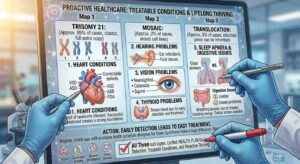
Regular check ups make a huge difference. Many of these conditions are easy to treat when found early. Ask your doctor for a health schedule designed for Down syndrome, because many countries have special guidelines.
Early Support: Therapies That Open Doors
The first years are precious because the brain learns very fast. Early intervention programmes can make a real difference. They usually include:
- Speech and language therapy: Helps with feeding, babbling, first words and clear speech. Many children understand more than they can say at first
- Physical therapy: Builds strength, balance and walking skills
- Occupational therapy: Helps with hand skills such as grasping, drawing, dressing and feeding
- Play at home: Short, playful daily activities with parents and siblings
Starting support early gives a child with Down syndrome more time to build skills at their own pace.
Milestones such as sitting, walking and talking still arrive, often a little later. Every new skill is worth celebrating loudly.
School Days: How Children Learn Best
Down syndrome is usually linked with mild to moderate intellectual disability, but each child learns differently.
Many children learn well with:
- Visual aids such as pictures, charts and real objects
- Clear routines and step by step instructions
- Lots of repetition and praise
- Hands on activities instead of long explanations
- Learning alongside classmates, because peers are great teachers
Inclusive classrooms, where children with different abilities learn together, benefit everybody. Classmates learn kindness and patience, and children with extra needs gain friends and role models. A good teacher, a patient team and a supportive family can work wonders.
Down Syndrome Across a Lifetime: From First Steps to Grey Hair
In 1983, the average life expectancy of a person with Down syndrome was around 25 years. Today it is about 60, thanks to better healthcare, successful heart surgeries and more inclusion in families and communities.
That is one of the biggest medical success stories few people talk about.
Adult life can include:
- Finishing school and joining further training or college programmes
- Working in retail, offices, hospitality, creative fields or family businesses
- Living with family, in shared homes or with support to live more independently
- Enjoying friendships, hobbies, relationships and sports
- Voting, volunteering and speaking up for themselves
Some well known people show what is possible. Chris Burke starred in the TV series Life Goes On, and Madeline Stuart walked the runway at New York Fashion Week as a model.
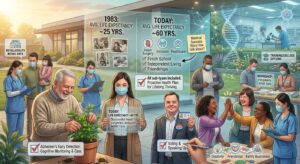
One health note: adults with this condition have a higher chance of developing Alzheimer’s disease at an earlier age than the general population, so doctors watch for changes in memory, mood or skills as people get older.
What New Parents Feel and Need to Hear
If you have just received the news, your feelings may swing from fear to sadness to love within the same hour. All of that is normal.
Here are some things many parents say they wish someone had told them:
- Your baby is a baby first. Feeding, cuddling and sleepless nights come before the diagnosis
- You do not need to know everything today. Learn step by step
- Connect with other families. Parent groups and local Down syndrome associations can offer advice, friendship and hope
- Ask for a referral to early intervention as soon as possible
- Take care of yourself and your partner, because tired parents cannot care for anyone
- Choose your information sources carefully and stick to trusted medical and parent organisations
Surveys of families have found that many parents feel proud of their child, and many siblings say the experience made them better people. Of course, there are hard days too, and that is part of every family. Life with Down syndrome has its challenges, but it also has a lot of joy. You will not be doing this alone.
Brothers, Sisters and Grandparents: The Wider Circle
A new diagnosis touches the whole family, not only the parents.
Brothers and sisters may feel curious, protective, confused or even a little left out. That is natural. Some ways to help:
- Answer their questions honestly, in words that match their age
- Spend one on one time with each child
- Let them be siblings, not caregivers
- Celebrate their achievements too
Grandparents may need time to process the news. Sharing simple facts and inviting them to appointments or therapy sessions can help them become strong sources of support.
Everyday Tips That Make Home Life Easier
Small habits can make the day smoother for everyone:
- Use daily routines, such as the same order for getting dressed and eating
- Show pictures of the day’s plan, which helps with understanding
- Speak in short, clear sentences and give extra time to respond
- Break big tasks into small steps
- Encourage independence, such as helping with chores, even if it takes longer
- Keep up with medical, hearing and vision check ups
Patience, praise and play go a long way.
Myths That Need Retirement
Myth: People with Down syndrome are always happy and sweet.
Truth: They feel the full range of emotions, just like everyone else. Stereotypes, even kind ones, make it harder to see the real person.
Myth: Down syndrome is an illness that can be cured.
Truth: It is a genetic condition, not a disease. It cannot be cured, but health and development can be supported very well.
Myth: People with Down syndrome cannot learn, work or live independently.
Truth: Many learn to read, write, work and live with different levels of support. The level of support differs from person to person.
Myth: Only older mothers have babies with it.
Truth: Most babies are born to mothers under 35.
Myth: Everyone with it looks the same.
Truth: People look like their own families first. Some features are shared, but faces and personalities are individual.
Words Matter: How to Talk About It Respectfully
Language shapes attitudes. A few simple habits help:
- Say “a person with Down syndrome” instead of “a sufferer” or “a Down’s child”
- Avoid hurtful slurs, including using disability related words as insults
- Use “typically developing” instead of “normal” when comparing
- Talk to the person, not about them
- Ask before helping, and never assume what someone cannot do
Respect costs nothing and means everything.
Down Syndrome Inclusion: What Every Community Can Do
Families do a lot, but communities decide whether a child feels welcome. Everyone can help:
- Employers: Offer fair hiring, training and a supportive workplace
- Schools: Provide trained teachers, resources and inclusive classrooms
- Neighbours: Invite everyone to birthdays, games and events
- Friends and family: Include the person in conversations and plans
- Everyone: Celebrate World Down Syndrome Day on 21 March. The date, 3/21, stands for the 3 copies of chromosome 21, and the United Nations has observed it since 2012
Small actions change lives. A smile, a job offer, a seat at the lunch table.
Quick Answers to Common Questions
Can adults live independently?
Many adults live fairly independently with the right support. The level of help needed differs from person to person.
Is it hereditary?
Most cases happen by chance and are not inherited. The translocation type can run in families, so genetic counselling can help.
Does it get worse with age?
No. The condition is present from conception and does not worsen, but health needs change with age, as they do for everyone.
Can it be prevented?
No. It happens by chance, and nothing a parent does can prevent it.
Where can families find support?
Ask your doctor about early intervention services, and look for local and national parent organisations and support groups.
Can people with it be healthy and happy?
Yes. With good healthcare, love and opportunity, many live full and meaningful lives.
Final Thoughts: The Extra Chromosome Is Only One Part of the Story
A chromosome count tells doctors something useful. But it tells you almost nothing about a person’s sense of humour, kindness, favourite song or stubborn streak.
Down syndrome is one part of who someone is. The rest is personality, family, friendship and dreams.
If you are a parent, you are stronger than you think, and the world is far more welcoming than it was a generation ago. If you are a reader, be curious, be kind and look at the person first.
Share this blog with someone who needs hope, or someone who needs better understanding. Both matter.
This blog is for education only and does not replace advice from a doctor.