
Free money. Those two words are enough to make anyone stop scrolling.
Now imagine opening your crypto wallet one morning and finding tokens you never bought. That is exactly what happens when a project rewards its community, and it is the simple idea behind crypto airdrops.
Sounds like a dream, right? Sometimes it is. Some early users of popular projects received rewards worth a surprising amount of money.
But there is a darker side. Scammers love crypto airdrops just as much as honest projects do, and they are very good at copying the real thing.
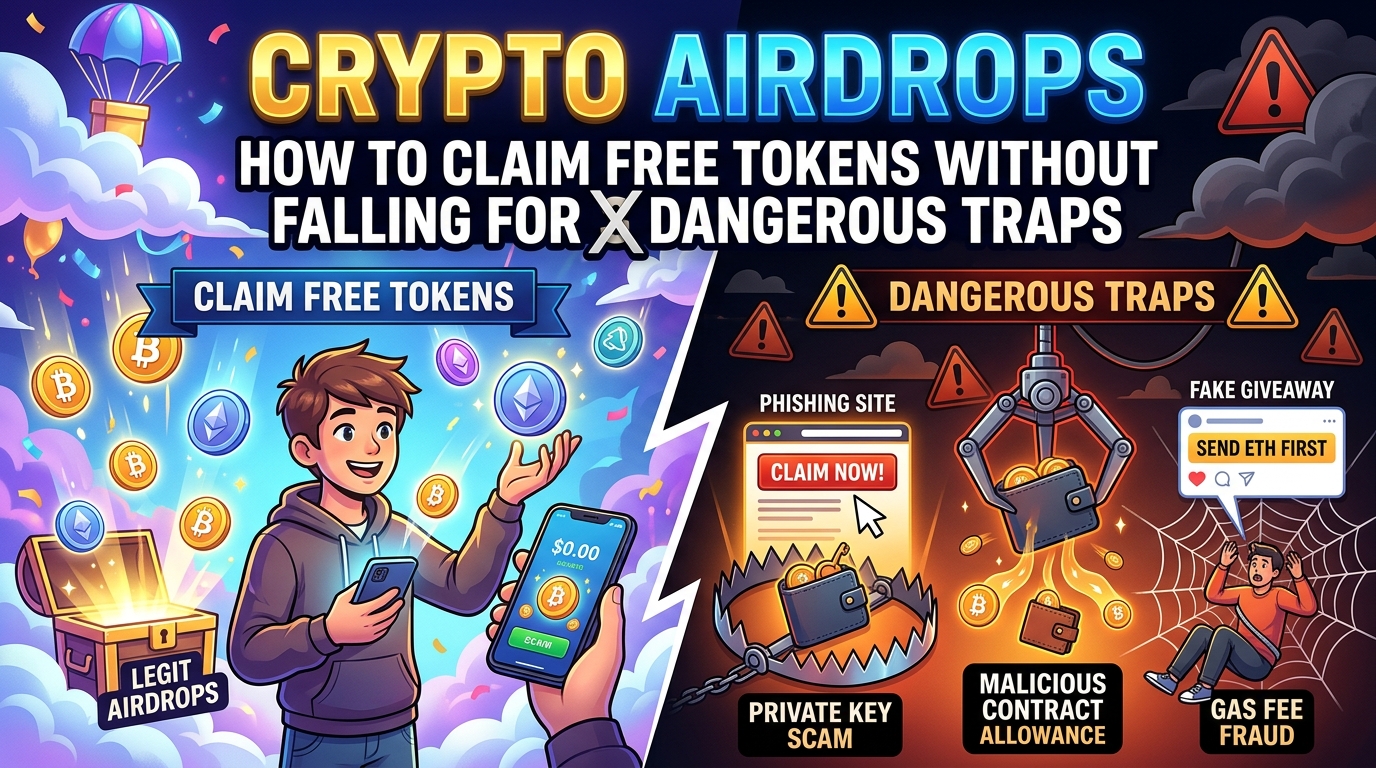
In this guide, I will show you how crypto airdrops really work, how to claim tokens safely, and how to dodge the 3 traps that catch most beginners.
Wait, Is Free Crypto Really Free?
Let’s start with the honest answer: sometimes yes, sometimes no.
A real airdrop is a project sending tokens to many wallet addresses, usually to reward early users or to spread ownership of the project. You do not pay for the tokens. At most, you pay a small network fee when you claim them.
The word “free” is where trouble begins. Scammers use it as bait. They build fake pages, send fake messages and promise big rewards, then empty your wallet instead.
So here is a rule worth remembering from the very start:
- A real airdrop never asks for your seed phrase
- A real airdrop never asks you to send crypto first to receive more
- A real airdrop never rushes you with a countdown and pressure

If any of these show up, walk away. That one habit protects you from most crypto airdrops scams.
The Story That Made Everyone Pay Attention
In September 2020, the decentralized exchange Uniswap launched its UNI token. Along with it came a surprise. Every wallet address that had used the platform before September 1, 2020 could claim 400 UNI.
At the time, that amount was worth well over a thousand dollars. People who had simply tried out an exchange months earlier suddenly had a nice reward waiting for them.
The news spread fast. Social media filled with stories about “free money,” and a whole new hobby was born: using new projects early in the hope of a future reward.
Another well known example came in March 2023, when the Ethereum scaling network Arbitrum distributed its ARB token to eligible users of its network.
These stories explain why crypto airdrops became so popular. They also explain why scammers followed the crowd.
Why Do Projects Give Tokens Away?
Giving away tokens might look strange, but it makes business sense. Here are the most common reasons:
- To reward early supporters: People who tested the product before it was famous get a thank you
- To spread ownership: More holders can mean a more decentralized community
- To get attention: A good reward gets people talking and trying the project
- To build a loyal community: Token holders often care more about where the project goes next
Think of it like a new cafe handing out free coffee on opening day. The owner is not being generous for nothing. They want you to taste the product and come back.

Understanding this helps you stay realistic. Crypto airdrops are a marketing and community tool, not a guaranteed paycheck.
What Happens Inside Your Wallet When You Claim
To take part in crypto airdrops, you need a self custody wallet. That simply means a wallet where you hold the keys yourself. MetaMask, Trust Wallet and Phantom are well known examples.
Every wallet has a public address, a bit like an email address. Projects check this address to see if it qualifies, and then send the tokens or let you claim them there. Sharing your public address is safe. Sharing your seed phrase is never safe.
There is one more detail that confuses beginners. Tokens live on a specific blockchain. Crypto airdrops on Ethereum show up on Ethereum compatible networks, while rewards on Solana appear in a Solana wallet. If you look on the wrong network, you might think nothing arrived. Always check which network the official announcement mentions.
And what if your coins sit on an exchange instead of your own wallet? Then the exchange decides whether you receive the reward and how, so watch its official announcements.
Crypto Airdrops Explained: The 4 Types You Will Meet
Not every airdrop works the same way. Knowing the type helps you know what to expect.
1. Standard Airdrops
You sign up or connect a wallet and receive a small amount of tokens. These are often used to introduce a new project.
2. Holder Airdrops
If you already hold a certain token, you may receive a new one. Your balance at a chosen moment decides your reward.
3. Retroactive Airdrops
The project rewards people for things they did in the past, like using the platform, trading or voting. The Uniswap and Arbitrum examples above fit here.
4. Task Based Airdrops
You complete small jobs such as following social accounts, joining a community or testing a feature. Be extra careful with this type, because scammers copy it the most.
Here is the thing to remember. Honest crypto airdrops explain their rules clearly on the official website. If the rules are vague, that is already a warning.

How Eligibility Really Works
Many beginners think everyone gets tokens. That is not true.
Projects usually take a snapshot, which is a record of wallet activity at a certain moment. Only wallets that meet the rules at that time can claim.
Rules can include:
- Holding a certain token in your wallet
- Using the platform a minimum number of times
- Being active before a specific date
- Not being flagged as a fake or duplicate account
That last point matters. Projects often try to filter out people who create many wallets to farm rewards. This is why some people with lots of wallets still get nothing.
Also remember that some tokens are locked. A project may release them slowly over time instead of all at once. Always read the official announcement before getting excited.
Five Myths That Need to Go
Before you invest your time in crypto airdrops, let’s clear up a few popular myths.
- Myth: Everyone gets free tokens. In reality, eligibility rules decide, and many people get nothing
- Myth: Airdropped tokens are always valuable. Some drop in price quickly, and some have almost no value at all
- Myth: More wallets mean more rewards. Projects often try to detect and exclude duplicate accounts
- Myth: A big following proves a giveaway is real. Scammers hack or copy popular accounts to post fake offers
- Myth: A professional looking site is safe. Logos and colors are very easy to copy

Believing these myths is how people lose money in crypto airdrops. Reality is calmer and less exciting, but it keeps your wallet safe.
Does Free Crypto Come With a Tax Bill?
Here is the part nobody puts in the exciting headlines.
In some countries, free tokens still count as income. According to a legal summary of United States IRS guidance, an airdrop that follows a hard fork and delivers new coins creates ordinary income (source: Hunton).
Other countries have different rules. Some are strict, some are still unclear.
So what should you do?
- Keep a simple record of when you received each token and its value on that day
- Check the tax rules in your own country
- Speak to a local tax professional if the amount is large
Free does not always mean tax free. Better to know early than to be surprised later.
Trap 1: The Fake Claim Website
This is the most common trap in crypto airdrops, and it works like this.
You see a post saying a famous project is giving away tokens. You click the link. The website looks perfect, with the right logo and colors. You connect your wallet and press “Claim.”
A window pops up asking you to approve something. You click confirm without reading it. That single click can give the scammer permission to move tokens out of your wallet. Tools that do this are often called wallet drainers.
Here is how to protect yourself:
- Open the project’s official website by typing the address yourself or using a link from its verified account
- Never trust links sent by strangers in private messages
- Ignore sponsored search results, because scammers pay for them too
- Read every wallet popup before you confirm
Remember that a hardware wallet does not protect you if you approve a bad request yourself. The device only does what you tell it to do.
Trap 2: The “Verify Your Wallet” Message
The second trap in crypto airdrops is more personal, and it hits people through messages.
Someone sends you a direct message on Telegram, Discord or social media. They say you won an airdrop or that your wallet needs verification. Then they ask for your seed phrase or private key.
Stop right there.
Your seed phrase is the master key to everything in your wallet. No real project, support agent or moderator will ever need it. Nobody. Not once.
Watch out for these common lines:
- “Your wallet is eligible, confirm now to avoid losing your reward”
- “Send a small amount first to unlock your tokens”
- “Support will help you, just share your recovery phrase”
Scammers also pretend to be official support staff. They copy names, photos and logos. If a stranger messages you first, treat it as a scam until proven otherwise.
Trap 3: Spam Tokens and Sneaky Approvals
Sometimes you do not even have to click anything. Tokens simply appear in your wallet.
It feels exciting at first. But random tokens you never asked for are usually spam. Scammers send them to thousands of wallets, hoping someone will be curious enough to investigate.
Here is how the trick usually works. The token’s name might include a website address or a message like “claim your reward.” If you visit that site and connect your wallet, you may end up approving something harmful.
So what is the safest move?
- Do not click links inside token names or descriptions
- Do not try to sell or swap a token you do not recognize
- Hide the token in your wallet app if you wish, or simply ignore it
- Check your wallet’s token approvals from time to time and cancel any you do not recognize

Approval checker tools, such as the ones offered by block explorers, let you see which sites can spend your tokens and remove their access. Make this a regular habit.
A Short Story: Maya and the Two Links
Imagine a beginner named Maya. She hears that a project she used last year is rewarding its early users. She searches online and finds two links. One sits in a sponsored ad at the top of the page. The other is posted on the project’s verified account.
She almost clicks the ad because it appears first. Then she remembers her rule: official sources only. She compares both addresses and notices something odd. The ad link has one extra letter.
So Maya uses the verified link, claims the tokens with a small wallet, and checks her approvals afterwards. Total time: about ten minutes. Total risk: low.
Her story is made up, but the situation is very real for anyone who follows crypto airdrops. The lesson is simple. In crypto airdrops, patience and a quick comparison beat excitement every single time. Most losses happen in the first thirty seconds, when people click before they think.
A Safe Claiming Routine You Can Follow
Ready to claim? Here is a simple routine for crypto airdrops that keeps you safer:
- Find the announcement on the project’s official website or verified account
- Compare the claim link across at least two official sources
- Use a separate wallet for claiming, not the one that holds your savings
- Make sure you have a little of the network’s native coin to pay the fee
- Read the wallet popup carefully before you confirm
- After claiming, check your approvals and remove anything unneeded
The separate wallet is the real hero here. Keep your main funds in a safe place, and use a small wallet for experiments. If something goes wrong, the damage stays small.
How to Check If a Project Is Real
Before you touch any claim button, spend five minutes on homework. Ask yourself:
- Does the project have a working product, not just a flashy website?
- Is there a clear team or company behind it, or a long public history?
- Do the official website, documentation and verified accounts all point to the same links?
- Are trusted community members or news sites talking about the reward?
- Does the claim page use the exact same web address everywhere you see it?
Real crypto airdrops leave a trail across many official places. Fake crypto airdrops usually rely on a single link that someone pushes in your face.
This small habit is the cheapest insurance you can buy.
Crypto Airdrops Red Flags Cheat Sheet
Save this list and use it every time you meet new crypto airdrops. It can protect you in seconds:
- A link arrives from a stranger or an unknown account
- The page asks for your seed phrase or private key
- You must send money before receiving tokens
- There is a strange countdown or fear based message
- The website address has small spelling mistakes
- The project has no clear history, team or official channels
- Rewards sound too big to be true
One red flag is a warning. Two is a reason to leave. Three means you should close the tab and move on.
Smart Habits for Airdrop Hunters
Some people try to qualify for crypto airdrops by using new projects early. This is often called airdrop farming. It can be interesting, but it needs a cool head.
Keep these habits in mind:
- Never spend more than you can afford to lose. There is no promise of a reward at the end
- Do not chase every project. Pick a few that you actually understand
- Use small amounts. Test first, then decide
- Stay patient. Many rewards take months or never arrive
- Track your activity. Write down which sites you used and when

Most important of all, remember that using a project does not guarantee tokens. Many people spend time and fees and receive nothing from crypto airdrops.
Your 60 Second Recap
Short on time? Here is the whole story in a few lines:
- Crypto airdrops are free token rewards sent to wallets, usually to grow a community
- Rewards depend on eligibility rules, snapshots and sometimes slow unlocking
- The 3 traps are fake claim websites, requests for your seed phrase, and spam tokens with sneaky approvals
- Use official links, a separate wallet and regular approval checks
- Keep records, because tax rules may apply in your country
- Treat crypto airdrops as a bonus, never as income you can count on
Common Questions About Crypto Airdrops
Do I need to pay to receive an airdrop?
You should never pay for the tokens themselves. You may pay a small network fee to claim, and that is normal.
Are all airdrops scams?
No. Many are real marketing programs from real projects. The danger comes from fake copies, so always verify the source.
Can I lose money by claiming?
Yes, if you connect to a fake site or approve a harmful request. That is why safe habits matter more than speed.
What should I do if I think I clicked a scam link?
Move your funds to a fresh wallet as quickly as you can, and cancel any suspicious approvals. Then stay away from the site.
Are crypto airdrops worth the effort?
They can be, but only if you stay realistic. Treat them as a possible bonus, never as a plan to get rich.
Final Thoughts: Free Tokens, Smart Rules
Crypto airdrops are one of the most exciting parts of the crypto world. Real ones reward real users and help communities grow. But the excitement is exactly what scammers use against you.
So slow down. Use official sources. Keep a separate wallet. Never share your seed phrase. And never let the word “free” make you skip a step.
Do that, and you can enjoy the upside of crypto airdrops while avoiding the 3 dangerous traps that catch everyone else.
This article is for education only and is not financial advice. Do your own research before you interact with any project.