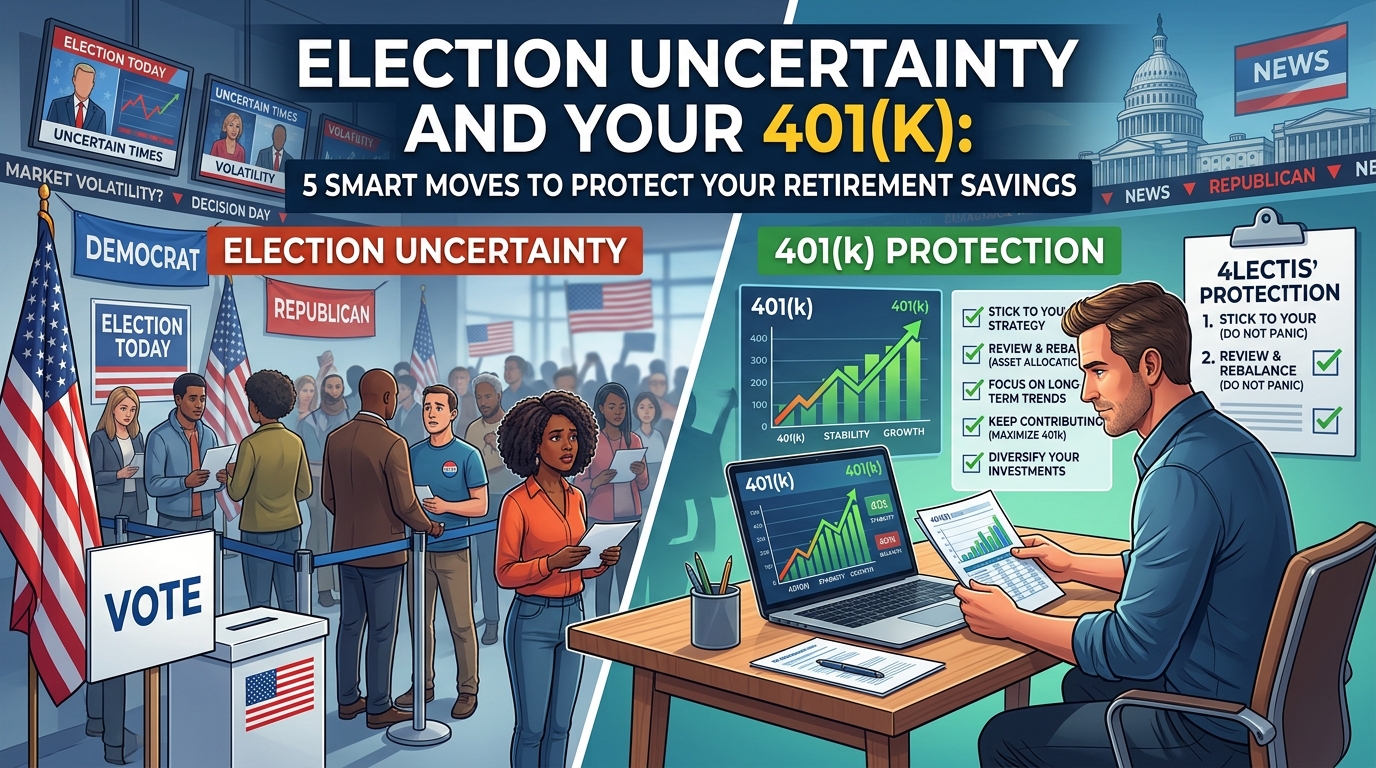
You open your retirement account. The balance has moved a little. Maybe up, maybe down. Then you turn on the news and hear about polls, debates and predictions.
Suddenly one question pops into your head. Should I do something with my 401(k) before the votes are counted?
It is a very human reaction. Every time elections come around, millions of workers start wondering if their retirement savings are in danger. Some even think about stopping contributions or moving everything to cash.
Before you touch a single button, read this guide. I will walk you through how elections relate to your 401(k), what history shows, and the 5 smart moves that can protect your savings without drama.
Take a Deep Breath: Why Elections Make Everyone Nervous
Let’s be honest about why this feels so stressful.
Elections bring uncertainty. People do not know who will win, what laws might change or how markets will react. And humans do not like not knowing.
Add a flood of headlines, loud opinions and social media arguments, and even calm investors start to feel jumpy.
Here is the thing, though. Your 401(k) is a long term account. Most people will keep it for decades. A few weeks of noise rarely matters as much as it feels like it does in the moment.

So the goal is not to predict elections. The goal is to build a plan that works no matter what happens. That is exactly what the 5 moves below will help you do.
First, What Is Your 401(k) Actually Doing?
A quick refresher helps, because a lot of confusion comes from not knowing how the account works.
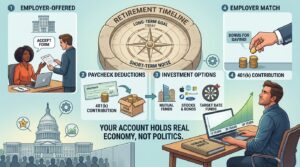
A 401(k) is a retirement plan offered through your employer. Money comes out of each paycheck and goes into investments you choose, like mutual funds or target date funds.
In many plans, your employer also adds money through a match. That is basically a bonus for saving.
Your account does not vote. It does not belong to a party. It holds investments in real companies and bonds, and their value changes with the economy, company profits and market mood.
That is why long term habits matter more than reacting to any single event, including elections.
Move 1: Keep Contributing, Especially for the Employer Match
The first and simplest move is to keep saving. Stopping contributions during uncertain times is one of the most common mistakes people make.
Why? Because regular contributions buy investments at many different prices. When prices dip, your money buys more shares. When prices rise, it buys fewer. Over time, this habit smooths out the bumps.
And if your employer offers a match, skipping contributions means leaving free money on the table.
Here are the 2026 limits set by the IRS, in case you want to save more:
- Regular limit: $24,500 for employee contributions to a 401(k)
- Catch-up for ages 50 and over: an extra $8,000
- Catch-up for ages 60 to 63: an extra $11,250 instead of the regular catch-up
You do not have to hit these numbers. Even a small increase of one percent in your contribution rate can help. Just make sure you at least collect your full employer match.
A Quick Math Example: What Pausing Really Costs
Numbers make this clearer, so here is a simple made up example.
Say someone earns $60,000 a year and puts 6 percent into their 401(k). That is $3,600 a year, or $300 a month. Now imagine their employer matches 50 percent of that amount. That adds another $150 a month, or $1,800 a year.
If this person pauses contributions for three months because of the elections, they skip $900 of their own savings and lose $450 of employer match. And that is before counting any growth those dollars could have earned.
Real plans have different match rules, so check yours. But the idea holds everywhere. Pausing has a real price, while the benefit of waiting for the elections to pass is usually just a feeling of relief.
Move 2: Check Your Mix and Do Not Put Everything in One Basket
The second move is to look at what you actually own.
Many people set up their 401(k) years ago and never checked it again. Some are heavily invested in one stock, one sector or their own company’s shares. That can turn into a problem fast if that one area has a bad stretch.
Diversification means spreading your money across different types of investments. Think of it like a meal. If you only eat one food, you miss out on a lot, and if that food goes bad, you are in trouble.
Here are a few quick questions to ask yourself:
- Is a big part of my money in a single company or industry?
- Does my mix match how many years I have until retirement?
- Do I understand what each fund in my plan holds?
If you do not want to manage this yourself, many plans offer target date funds. These funds pick a mix based on your expected retirement year and become more conservative as you get closer to it.
Move 3: Rebalance Calmly and Never Panic Sell
Now for the move that takes the most self control.
When markets get shaky, many people feel the urge to sell everything and wait for things to calm down. The problem is that nobody rings a bell at the bottom or the top. If you sell during a dip, you lock in the loss. Then you have to guess the right moment to buy back in, and that is very hard to do.
A calmer habit is rebalancing. This simply means returning your portfolio to your chosen mix once or twice a year. If stocks grew a lot, you may trim them a little. If bonds lagged, you may add to them.
It is boring, and that is the point. Boring habits protect wealth.
A few practical tips:
- Avoid checking your balance every day
- Set a calendar reminder to review your plan twice a year
- Write down your long term goal and read it before making any big change
Why Staying the Course Is Strategy, Not Laziness
Some people think doing nothing is a weak plan. In investing, it can be one of the strongest.
Timing the market around elections is extremely hard because it needs two correct decisions: when to get out and when to get back in. Miss either one and the result can be worse than staying put.
Staying the course, on the other hand, means you stick with a plan that you built when you were calm. You already thought about your goals, your age and your comfort with risk. Elections should not erase that thinking.
Here is a helpful trick. Before you make any change, wait 48 hours and write down why you want to do it. If the reason is “I am scared of what the news said,” that is a sign to pause.
Good investors are not people who never feel fear. They are people who do not let fear make the decisions. News cycles test that skill more than almost any other event.
How Elections Can and Cannot Touch Your Money
Let’s separate fact from fear.
Elections can influence future policies on taxes, spending, regulation and the economy. That is real. But those changes usually take time, because new laws have to move through Congress before they take effect.
What elections cannot do is wipe out your account overnight or take your 401(k) away. Your money is held in your plan and invested in the funds you chose.
Many analysts also point out that economic conditions, such as growth, inflation and interest rates, have tended to matter more for the market than the result of any single vote.
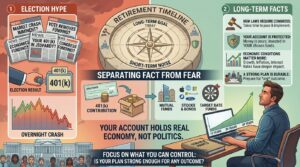
So rather than asking “who will win?”, a better question is “is my plan strong enough for any outcome?”
If the answer is yes, elections become just another news event, not a threat.
A Reality Check From History
Let’s look at what the past says, while remembering that history never guarantees the future.
A Motley Fool analysis of market data going back to 1874 found that the S&P 500 rose in the 12 months after 32 of the 38 midterm elections it studied (source: Motley Fool).
That does not mean the market always rises after a vote. It also does not mean the next one will repeat the pattern. In the other six periods the market did not rise, and every period has its own story.
What it does show is that elections have not stopped long term investors from eventually moving forward. Uncertainty feels scary in the moment, but it often looks smaller when you see it years later.
The lesson is not “buy because history says so.” The lesson is “do not make drastic choices based on fear.”
A Quick Story: Two Coworkers, Two Choices
Imagine two coworkers named Daniel and Ayesha. Both are in their late thirties, and both are nervous about the upcoming elections.
Daniel decides to pause his 401(k) contributions until the results are clear. He moves his balance into cash “just for a while.” The headlines keep changing, and weeks turn into months. He misses employer matches and has to decide when to jump back in.
Ayesha does something different. She keeps her contributions going, checks her fund mix once and leaves it alone. She feels the same nerves as Daniel, but she trusts her plan.
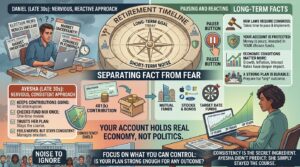
Both are made up, but the situation is very common. Ayesha did not predict anything. She simply stayed consistent. And consistency is the secret ingredient behind most successful retirement stories.
What Happens After November 3?
The midterm elections are set for November 3, 2026, but your investing life does not end that evening.
Results may take some time to confirm in close races. Markets can wobble during that waiting period. The new Congress is then sworn in the following January, and real changes to laws take months of debate.
That timeline matters. It means there is plenty of time to read, learn and adjust your plan thoughtfully, rather than react in a rush the morning after elections.
There is also something practical to watch. The IRS usually announces next year’s contribution limits in the fall, so keep an eye out for the 2027 numbers. A higher limit gives you more room to save.
And remember that elections are only one source of news. Interest rate decisions, job reports and company earnings will keep moving markets long after the votes are counted.
Move 4: Spread Your Tax Risk With Roth and Traditional Accounts
The fourth move is about taxes, and it is often overlooked.
Many 401(k) plans offer two types of contributions:
- Traditional: you contribute before tax, which lowers your taxable income now, and you generally pay tax when you withdraw
- Roth: you contribute after tax, and qualified withdrawals in retirement are generally tax free
Which one is better? Nobody knows, because nobody knows what tax rules will look like decades from now. Laws can change, and elections are one of the ways political priorities shift.
That is why many people use both. It is called tax diversification. Having money in different tax buckets gives you more choices later when you start withdrawing.
Not every plan offers a Roth option, so check with your employer or plan administrator. And if your income is high or you are not sure which choice fits, a tax professional can help you decide.
Move 5: Build a Cash Cushion So You Never Raid Your Retirement
The fifth move is not inside your 401(k) at all. It is a safety net outside it.
When people face a surprise expense or lose a job, they sometimes reach into their retirement account. But withdrawing before age 59 and a half usually means paying income tax plus an extra 10 percent penalty, with some exceptions. That can eat a big chunk of your savings, and you also lose future growth on that money.
An emergency fund prevents this. Aim to keep a few months of living expenses in a savings account that you can reach quickly.
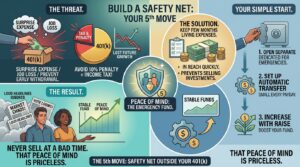
Here is a simple way to start:
- Open a separate savings account for emergencies
- Set up a small automatic transfer every payday
- Increase the amount whenever you get a raise
With cash on the side, you never have to sell investments at a bad time just to pay a bill. That peace of mind is priceless when headlines get loud.
A Special Note If You Are Close to Retirement
If you are within five to ten years of retirement, the stakes feel higher, and that is fair. A big drop right before you start withdrawing can hurt more than the same drop at age thirty, because you have less time to recover.
That is why people near retirement often review how much of their money sits in stocks, and keep some in safer investments for the first years of spending. This is sometimes called a bucket approach.
It is not about running away from the market. It is about making sure the money you need soon is not exposed to big swings. A financial professional can help you build this plan around your own timeline, income and comfort with risk.
Five Mistakes to Avoid During Election Season
Even smart people slip up when emotions run high. Watch out for these:
- Stopping contributions out of fear: you may lose the match and the benefit of buying at lower prices
- Moving everything to cash: you could miss a recovery
- Following political tips blindly: stock tips tied to a party or candidate are not a plan
- Ignoring fees: high fund costs quietly reduce your returns every single year
- Forgetting beneficiaries: check that your beneficiary information is current
None of these mistakes are about elections themselves. They are about reacting emotionally to elections. That is a habit you can change.
Your 5 Minute Checklist
Short on time? Do these things this week:
- Confirm your contribution rate and your employer match
- Look at your fund mix and make sure it fits your timeline
- Decide if a Roth option makes sense for part of your savings
- Check that your emergency fund exists, even if it is small
- Update your beneficiaries if anything in your life has changed
That is it. Nothing fancy. These five small actions do more for your future than any prediction about elections ever could.
Five Questions to Ask Your Plan Administrator
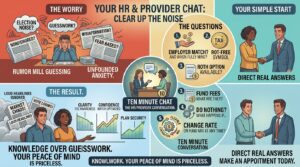
A short chat with your HR team or plan provider can clear up a lot of worry. Here is what to ask:
- What is my employer match, and when does it become fully mine?
- Is a Roth option available in our plan?
- What fees do the funds in my plan charge?
- What happens to my money if I do nothing and leave my current settings alone?
- Can I change my contribution rate or fund mix at any time?
Asking these questions takes ten minutes and gives you real answers, which is much better than guessing based on what you hear about elections.
Common Questions About Elections and Your 401(k)
Should I stop contributing until the elections are over?
For most people, no. Regular contributions are designed to work through ups and downs, and stopping may cost you your match.
Should I move my 401(k) to cash before elections?
Moving to cash means you have to be right twice, once when you sell and again when you buy back. That is hard to do consistently. Speak with a financial professional before making a big move.
Does the winning party change my 401(k)?
Policies can change over time, but your account stays yours. Many analysts note that economic conditions have mattered more than which party wins.
What if I am close to retirement?
Then your mix matters even more. Review how much of your money is in stocks, and consider keeping some cash or safer investments for near term spending needs.
How often should I check my account?
A couple of times a year is plenty for most people. Checking daily tends to increase stress without improving results.
Final Thoughts: Your Plan Is Bigger Than One Vote
Elections will come and go. Headlines will shout, predictions will pile up and everyone will have an opinion.
But your retirement plan is built on something steadier: regular saving, a mix of investments that fits your timeline, a cash cushion and a calm mind.
Keep contributing. Check your mix. Rebalance without panic. Think about taxes. Protect yourself with an emergency fund. Do those 5 things, and you will be ready for whatever the next elections bring.
This article is for education only and is not financial advice. Everyone’s situation is different, so consider speaking with a qualified financial advisor or tax professional before making decisions about your retirement savings.