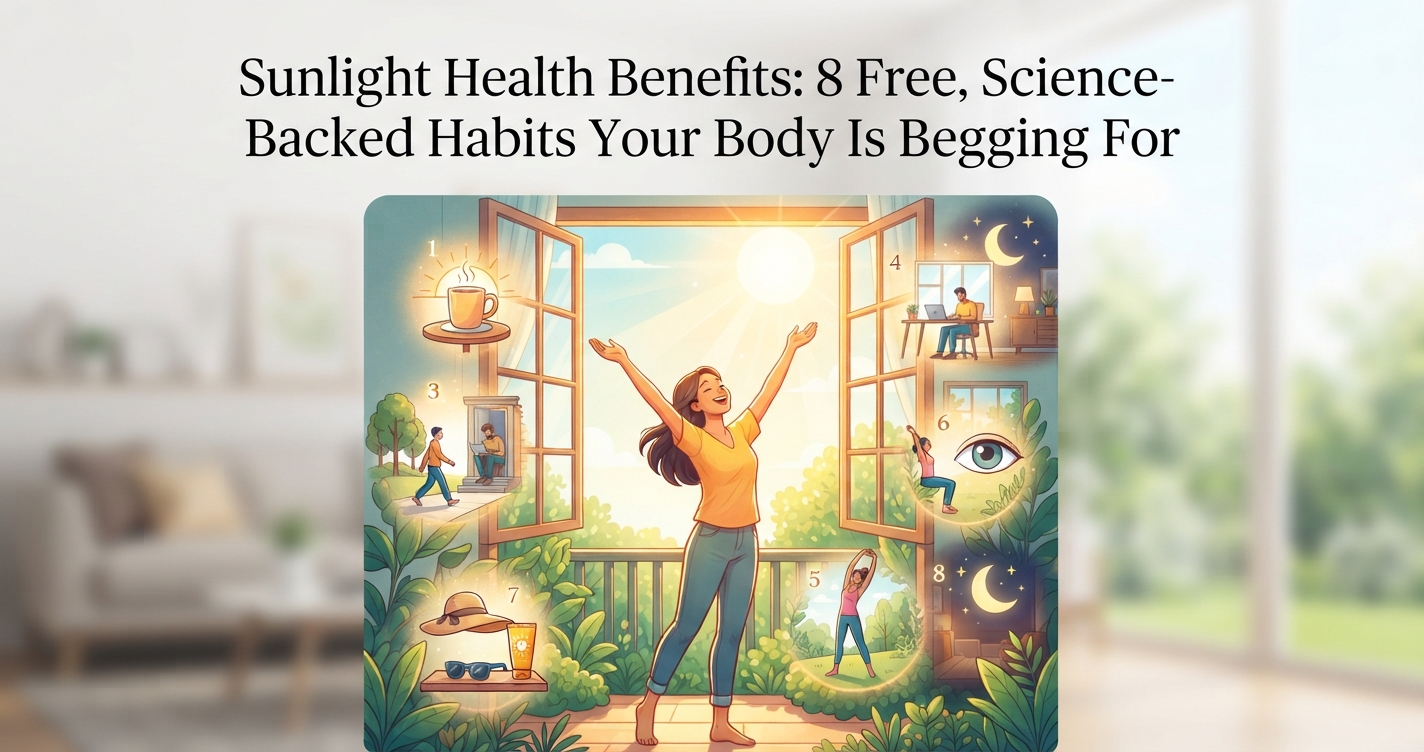
Think about the last time you spent a full hour outside in daylight. Not the walk from the car to the office, and not five minutes in a doorway with your phone. A real hour. For a lot of us, it has been a while.
We wake up in dim bedrooms, sit under ceiling lights all day, and scroll through glowing screens at night. Our bodies were built for a very different rhythm, one that begins and ends with the sky.
The good news is that one of the oldest health tools we have costs nothing. Sunlight has been studied for well over a century, and the research keeps pointing the same way: sensible, regular exposure supports your bones, your sleep, and your mood.
The key word there is sensible. Too much sun damages your skin, and I’ll be upfront about that risk later in this post. But too little is a problem as well, and it is one people rarely think about.
Below are eight simple habits that use daylight the way your body expects. None of them needs a gym membership, a gadget, or a supplement. Just a door you can open.
Why Your Body Treats Daylight Like a Daily Requirement
Humans spent nearly all of their history outdoors. Our biology grew up under an open sky, and it still expects a few signals from it.
Here are the three big ones, in plain language:
- Your skin makes vitamin D. When ultraviolet B rays in sunlight reach bare skin, your body converts a compound in the skin into vitamin D3.
- Your eyes set your body clock. Light-sensing cells in the retina send messages to the brain’s master clock, telling it that morning has arrived.
- Your brain responds to brightness. Light exposure influences the chemistry tied to alertness and mood, which is one reason dark winter months feel heavy for many people.
Notice that none of this depends on a tan. You don’t need to bake in the heat. You need regular contact with real sunlight, and most indoor spaces simply do not deliver it.

To put numbers on it, a typical office is lit at around 300 to 500 lux. A cloudy day outside usually delivers several thousand lux, and a bright clear day can reach about 100,000. That gap is huge, and your body notices it even when you do not.
Habit 1: Greet the Morning Before You Greet Your Phone
If you only adopt one habit from this list, make it this one. Within an hour of waking up, get outside into the sunlight for a few minutes.
Morning light is one of the most powerful signals your body clock receives. It tells your brain that the day has begun, which helps set the timing for alertness now and for sleepiness later that night.
People who get bright light early in the day tend to fall asleep more easily at night. Some sleep experts suggest around five to ten minutes on a clear morning and ten to twenty minutes when it is cloudy, though there is no magic number.

Easy ways to make it happen:
- Step onto your balcony, porch, or garden with your first cup of tea or coffee.
- Walk to the corner shop or take a short loop around the block before you sit down to work.
- Open your curtains the moment you get up, even if you cannot go out yet.
One safety note: never look straight at the sun. Just being outside in open sunlight is enough, and your eyes will take in what they need from the surroundings.
Habit 2: Move Your Breakfast or Coffee to the Doorstep
New habits stick best when they are attached to something you already do. Behavior experts call this habit stacking, and it works because the old routine acts as a built-in reminder.
Most of us eat something or drink something warm every morning. So take it outside. Ten minutes on the step with a cup in your hand is a perfectly good way to soak up some sunlight before the day gets busy.

A few ways to make it feel natural:
- Keep a small chair or stool near your door or balcony.
- Read the news, plan your day, or simply do nothing for a few minutes.
- On rainy days, sit by the brightest window you have and enjoy whatever sunlight breaks through.
- Invite a family member or a neighbor to join you. Company makes habits easier to keep.
It sounds almost too simple, and that’s exactly the point. The best health habits are the ones you’ll still be doing six months from now, not the ones that need heroic willpower.
Habit 3: Take a Midday Walk and Let Your Skin Make Vitamin D
Around lunchtime the sun is near its highest point, and that matters for vitamin D. UVB rays in sunlight, the type your skin needs to make the vitamin, are strongest around midday and much weaker in the early morning and late afternoon.
According to the U.S. National Institutes of Health, your body makes vitamin D when bare skin is exposed to sunlight, and food and supplements are the other sources (reference: https://ods.od.nih.gov/factsheets/VitaminD-Consumer/).
Why does this vitamin matter? It helps your body absorb calcium, which keeps your bones and teeth strong. Severe, long-term shortage can cause rickets in children and a bone-softening condition called osteomalacia in adults.
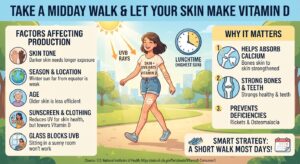
How fast your skin makes it depends on several things:
- Skin tone: more melanin means slower production, so darker skin often needs longer exposure.
- Season and location: far from the equator, winter sun is often too weak to make much vitamin D.
- Age: older skin makes the vitamin less efficiently.
- Sunscreen and clothing: they reduce UV reaching your skin, which is good for skin health but lowers vitamin D output.
- Glass: windows block most UVB, so sitting in a sunny room will not do the job.
There is no single perfect number of minutes for everyone. A short walk most days is far smarter than one long, risky session on the weekend, and it fits easily into a lunch break.
Habit 4: Sit by the Window and Let the Sunlight In
Not everyone can spend the day outdoors, and that is fine. What you can control is how much natural light reaches you while you work.
Sunlight through a window will not give you vitamin D, but it is still much brighter than most indoor lamps. It supports alertness during the day and keeps your body clock better anchored than a dim room does.

Small changes that make a real difference:
- Move your desk closer to a window, or face it toward the light.
- Keep blinds and curtains open during the day.
- Take phone calls next to the window, or better, outside.
- Clean your windows. Dirty glass filters out more light than you would think.
- Choose a bright cafe or library spot when working away from home.
Think of window light as a helpful supporting act, not the main show. Real outdoor time still beats it by a wide margin, so use both when you can.
Habit 5: Trade the Treadmill for a Trail Now and Then
Exercise is good for you. Exercise outdoors adds a bonus: sunlight, fresh air, and a change of scenery.
Research on what scientists call green exercise has found that even short bouts of activity in natural settings can improve mood and self-esteem. People also tend to enjoy outdoor workouts more than indoor ones, which makes them easier to repeat.
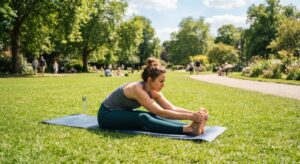
You don’t need to train for a marathon. Try any of these:
- A brisk walk in a nearby park or along a quiet road.
- Stretching, yoga, or bodyweight exercises on a patio or lawn.
- Cycling to work or to the market instead of driving.
- Gardening, which counts as movement and gets you outside for hours.
One caution for hot climates: exercise in the cooler early morning or evening hours, drink plenty of water, and stop if you feel dizzy or unwell. Heat exhaustion is real, and it is not worth the risk.
Habit 6: Give Your Eyes (and Your Kids’ Eyes) an Outdoor Break
Here is a benefit most people never hear about. Studies in several countries have linked more time outdoors with a lower risk of nearsightedness in children.
Some school-based trials that added extra outdoor time to the day saw fewer children develop the condition. Scientists are still working out exactly why, but exposure to bright outdoor sunlight is one of the leading theories.
So if you have children, sending them outside to play in the sunlight is not just a way to burn energy. It may be helping their eyesight too.

Adults benefit from looking up and away from screens as well. Eye doctors often recommend the 20-20-20 rule:
- Every 20 minutes, look at something about 20 feet away for at least 20 seconds.
- Even better, pick a distant tree, a street, or the open sky.
Protect those eyes too. A wide-brimmed hat and sunglasses that block UV rays are worth wearing on bright days, since long-term UV exposure is linked to eye problems such as cataracts.
Habit 7: Practice Smart Sun, Not Reckless Sun
Now for the honest part. Everything above is only worth doing if you protect your skin. Ultraviolet radiation is a proven cause of skin cancer, and sunburn, especially in childhood, raises the risk of melanoma later in life.
The goal is enough sunlight to gain the benefits without ever burning. Here is how to do that:
- Check the UV index. When it reaches 3 or higher, sun protection is recommended.
- Use a broad-spectrum sunscreen with SPF 30 or higher on skin that will be exposed for long periods, and reapply every two hours, or after swimming or sweating.
- Seek shade during the hours when the sun is strongest, usually late morning to mid-afternoon.
- Cover up with a hat, sunglasses, and light clothing on long days outside.
- Skip tanning beds completely. The World Health Organization’s cancer agency classifies them as carcinogenic to humans.
Remember that clouds do not block all UV, and darker skin can still be damaged even though it burns less easily. Fair skin, a history of skin cancer, or certain medications that increase sun sensitivity are all good reasons to talk with a doctor about the right amount of sunlight for you.

Habit 8: Dim the Evening So the Day Can Shine
Here is a twist: one good way to get more from your daytime sunlight is to protect your nights. Your body clock works on contrast. A bright day and a dim evening tell it clearly when to be awake and when to wind down.
Bright light at night, especially the blue-rich light from phones, tablets, and LED screens, can delay the release of melatonin, the hormone that signals bedtime. In one well-known study from Harvard-affiliated researchers, people who read on a light-emitting e-reader before bed fell asleep more slowly and felt less alert the next morning than those who read a printed book.

Simple ways to wind down:
- Lower the lights in your home an hour or two before bed.
- Switch on night mode, or better, put screens away and pick up a book.
- Use warm, low-wattage bulbs in the bedroom and keep the room as dark as you comfortably can.
- Take a slow evening stroll at sunset. Gentle, fading light is a lovely way to end the day.
Is Your Body Asking for More Sunlight?
Some signs suggest you may be short on sunlight. None of these proves anything on its own, but together they are worth noticing:
- You feel groggy for hours after waking, even after a full night in bed.
- You lie awake at night and only feel sleepy very late.
- Your mood dips noticeably when the days get short and gray.
- You spend most days indoors and rarely notice the weather.
Please keep one thing in mind. These signs are common and have many possible causes, and mild vitamin D shortages often cause no clear symptoms. The only way to know your vitamin D level is a blood test, so ask your doctor if you are concerned.
The encouraging part is that daily light habits are low effort. Small doses of sunlight, repeated most days, add up faster than most people expect.
What About Food and Supplements?
Sunlight is not the only source of vitamin D, and on dark winter days it may not be enough. Diet can help fill the gap.
Good food sources include:
- Fatty fish such as salmon, trout, mackerel, and sardines.
- Egg yolks.
- Milk, plant milks, and cereals that are fortified with vitamin D.
- Mushrooms that have been exposed to UV light.
Supplements are useful for some people, especially those who get little sunlight or have a confirmed deficiency. But more is not better. Very high doses over time can push calcium too high in the blood and cause real harm, so check the right dose with your doctor first.
A Simple Sunlight Plan for a Normal Day
All eight habits can fit into one ordinary day without turning your schedule upside down. Here is what it might look like:
- Morning: open the curtains, then take your tea or coffee outside for ten minutes of morning sunlight.
- Work hours: keep your desk near a window and take short breaks to look at the sky.
- Lunch: walk outside for a while around midday, with sun protection if the UV index is high.
- Afternoon: follow the 20-20-20 rule to rest your eyes, ideally with a view of something distant.
- Late afternoon or early evening: exercise outdoors, or take the family for a walk when the heat has eased.
- Night: dim the lights, put your phone away, and let your body settle.
You will not manage every step every day, and that is completely normal. Aim for progress, not perfection. Even two or three of these habits, done regularly, can shift how you feel.
Sun Myths That Deserve Retirement
A lot of confusion surrounds this topic, so let’s clear up a few common myths.
- Myth: a tan means you are healthy. Fact: a tan is your skin’s response to UV damage, not a sign of good health.
- Myth: cloudy days are safe. Fact: a large share of UV rays can pass through clouds, so burns are still possible.
- Myth: you can get vitamin D through a window. Fact: glass blocks most UVB, the rays your skin needs.
- Myth: dark skin does not need sun protection. Fact: darker skin has more natural protection, but it is not immune to sun damage or skin cancer.
- Myth: more sunlight is always better. Fact: benefits come from regular, moderate exposure, and burning brings real risks.
- Myth: sunscreen makes you vitamin D deficient. Fact: studies generally have not linked everyday sunscreen use to vitamin D deficiency, partly because most people apply too little.
If you remember only one thing from this list, let it be this: enjoy the sunlight, but never at the price of a burn.
Who Needs to Take Extra Care
Most healthy adults can follow these habits safely, but some people should be more careful or ask a doctor first:
- Babies under six months, who should be kept out of direct sunlight altogether.
- People with a personal or family history of skin cancer.
- People who take medicines that make skin more sensitive to sun, such as some antibiotics.
- Anyone with a skin condition or an immune condition that reacts to light.
When in doubt, a quick chat with your doctor or pharmacist is the smartest first step. This post is general information and is not a replacement for personal medical advice.
Final Thoughts: Your Body Is Waiting Outside
We spend so much money and energy searching for complicated health fixes. Meanwhile, sunlight, one of the most powerful and least expensive health tools we have, arrives every morning whether we notice it or not.
Here is a quick recap of the eight habits:
- Greet the morning outdoors within an hour of waking.
- Take your breakfast or coffee to the doorstep.
- Walk outside around midday for vitamin D.
- Work near a window.
- Exercise outdoors when you can.
- Rest your eyes and get kids outside.
- Protect your skin from burning.
- Dim your evenings.
Start small. Pick just one habit this week, maybe the morning cup of tea outside, and repeat it until it feels automatic. Then add another. Small steps taken consistently beat big plans that never begin.
Your body has been asking for this all along. Tomorrow morning, open the door, step outside, and give it what it has been waiting for: a little sunlight, a little patience, and a lot of common sense.