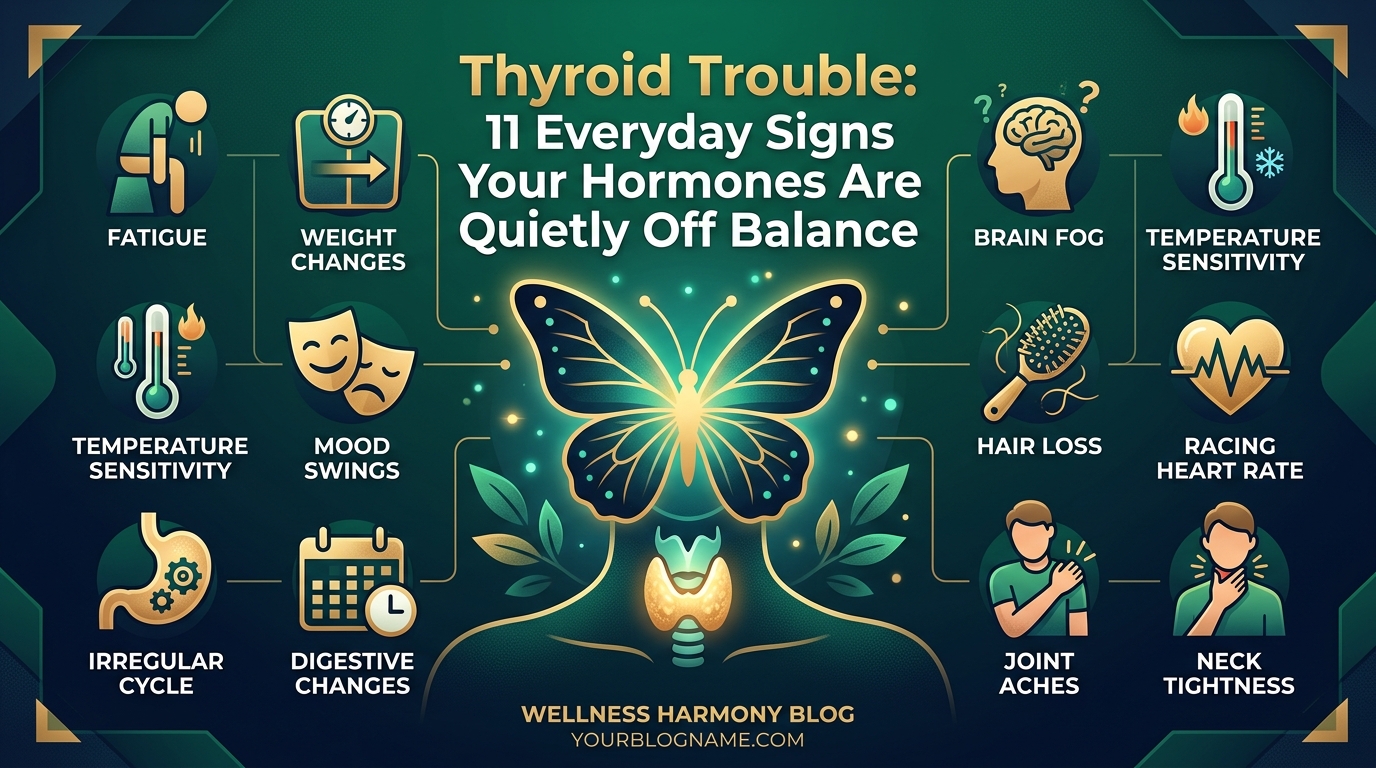
Your thyroid is small. It sits quietly in your neck, barely the size of a butterfly, and most people never think about it until something goes wrong.
But here’s the thing. This tiny gland controls how fast or slow almost every process in your body runs. Your energy, your weight, your mood, your heart rate, even how your skin and hair behave. When your thyroid quietly slips out of balance, it doesn’t announce itself with a dramatic symptom. It shows up as small, easy to dismiss changes that most people blame on stress, aging, or just having a busy life.
That’s exactly why thyroid problems go unnoticed for so long. Let’s look at what your thyroid actually does, why its signals are so easy to miss, and the everyday signs that your thyroid might be quietly asking for help.
The Gland Nobody Thinks About Until It Fails
Ask most people to name an organ that runs their whole body, and they’ll say the brain or the heart. Almost nobody says thyroid, yet this small gland produces hormones that influence how every single cell in your body uses energy.
When your thyroid works well, you don’t notice it at all. Your metabolism runs smoothly, your mood stays fairly stable, and your body regulates its own temperature without you thinking twice. It’s only when your thyroid starts producing too much or too little hormone that its influence becomes obvious, and even then, the signs are usually mistaken for something else entirely.
This is part of why thyroid conditions are so widely underdiagnosed. The symptoms overlap with everyday tiredness, stress, and normal aging, so people rarely connect the dots back to their thyroid.
Why Thyroid Problems Hide in Plain Sight
Thyroid issues are strange in that they rarely feel like a single, clear problem. Instead, they show up as a collection of vague changes that build slowly over months or even years.
According to the American Thyroid Association, an estimated 20 million Americans live with some form of thyroid disease, and up to 60 percent of them don’t even know they have it. (source) That statistic alone says a lot about how easily thyroid problems slip past unnoticed.

Part of the reason is that thyroid hormone affects so many different systems at once. A slowdown in thyroid function can look like fatigue, weight gain, hair thinning, or low mood, none of which scream “thyroid” on their own. So people chase individual symptoms instead of looking at the bigger picture, while the actual thyroid issue keeps going unaddressed.
1. You’re Exhausted No Matter How Much You Sleep
This is usually the first sign people notice, and the first one they dismiss.
When your thyroid is underactive, a condition called hypothyroidism, your metabolism slows down. Your cells simply have less energy to work with, no matter how many hours you spend in bed. This is different from ordinary tiredness. It’s a heavy, sluggish exhaustion that doesn’t lift even after a full night’s sleep.
Signs this fatigue might be thyroid related rather than just “being busy”:
- Needing a nap most afternoons, even after 8 hours of sleep
- Feeling mentally foggy along with the physical tiredness
- Struggling to get out of bed despite going to sleep early
If you’ve ruled out obvious causes like poor sleep habits or overwork, and the exhaustion still lingers, your thyroid is worth a closer look.
2. Your Weight Keeps Changing Without a Clear Reason
Weight changes are often the loudest thyroid clue, yet they’re also the easiest to misread.
An underactive thyroid slows your metabolism, which can lead to gradual, unexplained weight gain even without changes to your diet. On the flip side, an overactive thyroid, known as hyperthyroidism, speeds everything up and can cause noticeable weight loss even when you’re eating normally or more than usual.
What makes this confusing is that people usually blame their diet or their exercise routine first, when the actual cause might be sitting in their thyroid.

Signs worth paying attention to:
- Gaining weight steadily despite no real change in habits
- Losing weight without trying, especially alongside a racing heartbeat
- Feeling like your metabolism has “switched” from what it used to be
Thyroid related weight changes tend to be gradual and stubborn rather than sudden, which is exactly what makes them easy to overlook for months.
3. Your Mood Feels Off in Ways You Can’t Explain
Mental health and thyroid function are far more connected than most people realize.
An underactive thyroid can bring on low mood, flat energy, and a general sense of emotional heaviness that looks a lot like depression. An overactive thyroid, on the other hand, often causes anxiety, irritability, and a jittery, on edge feeling that doesn’t seem to match anything actually happening in your life.
This is where thyroid problems get tricky. Many people are treated for anxiety or depression without anyone ever checking their thyroid, when hormone imbalance is actually driving the mood shift.
Emotional signs that could point back to your thyroid:
- Feeling persistently low or flat with no clear trigger
- Sudden irritability or restlessness that feels out of character
- Mood swings that don’t line up with your usual patterns
If your mood has shifted noticeably and nothing in your life explains why, it’s worth asking whether your thyroid could be part of the picture.
4. You’re Always Cold, or Always Overheating
Temperature regulation is one of the most overlooked thyroid clues, mainly because people simply chalk it up to “just how I am.”
Your thyroid plays a direct role in regulating body temperature. When it’s underactive, you may feel cold constantly, even in warm rooms or mild weather, because your metabolism has slowed and your body is generating less internal heat. An overactive thyroid does the opposite, often leaving people feeling overheated, sweaty, or uncomfortable even in cool conditions.

Common patterns people notice:
- Needing extra layers or blankets when everyone else feels comfortable
- Feeling flushed or sweaty in situations that shouldn’t cause it
- Cold hands and feet that don’t seem to improve
On their own, these feel like personality quirks. Alongside other signs on this list, they start to look more like a thyroid pattern.
5. Your Hair, Skin, and Nails Are Changing
Thyroid hormone affects the growth cycle of hair, skin, and nails, which is why changes here often show up before people think to check their thyroid at all.
An underactive thyroid can lead to dry, coarse skin, thinning hair, and hair that seems to be shedding more than usual, especially around the eyebrows. An overactive thyroid can cause skin that feels unusually warm and moist, along with hair that becomes fine and brittle.
Physical signs worth noticing:
- Hair thinning or shedding more than what feels normal
- Dry, rough skin that doesn’t respond to your usual moisturizer
- Brittle nails that break or peel more easily than before
These changes are often blamed on stress, weather, or aging, when the real driver is sitting quietly in the thyroid gland.
6. Your Heart Rate Feels Unusually Fast or Slow
This sign gets missed the most, mostly because people don’t think to check their pulse unless something feels seriously wrong.
Thyroid hormone directly influences heart rate. An overactive thyroid can cause your heart to race or skip beats, even while you’re sitting still and relaxed. An underactive thyroid tends to do the opposite, slowing your heart rate down and sometimes making you feel unusually breathless during activities that used to feel easy.

Signs to keep an eye on:
- A resting heart rate that feels faster than usual, without exercise or caffeine to explain it
- Feeling your heart pounding or fluttering randomly during the day
- Getting winded more easily than you used to during normal activity
Because these signs can overlap with anxiety, fitness levels, or general stress, they’re rarely connected back to the thyroid until other symptoms pile up alongside them.
7. Your Digestion Has Quietly Changed
Digestion is another place thyroid problems love to hide, mostly because people assume gut issues are always about food.
An underactive thyroid slows down digestion along with everything else, which often leads to ongoing constipation that doesn’t respond well to the usual fixes like more fiber or water. An overactive thyroid tends to speed things up instead, sometimes causing more frequent bowel movements or a general feeling that your digestion has sped up for no obvious reason.
Digestive clues worth noticing:
- Constipation that’s become a regular pattern rather than an occasional issue
- Digestion that suddenly feels faster than usual, without any diet changes
- Bloating that doesn’t line up with what you’ve eaten
Most people troubleshoot this with diet changes first, when a sluggish or overactive thyroid could be the actual reason digestion feels off.
8. Your Cycle Feels Unpredictable
For women, thyroid imbalance often shows up first in the menstrual cycle, yet it’s rarely the first place anyone looks.
An underactive thyroid can lead to heavier, longer, or more irregular periods, along with worsened cramping. An overactive thyroid tends to do the opposite, often making periods lighter or less frequent than usual. Thyroid hormone is closely tied to reproductive hormones, so when one shifts, the other often follows.

Signs that your cycle might be thyroid related:
- Periods that have become noticeably heavier or longer
- Cycles that have become irregular without an obvious cause
- New or worsening fertility struggles alongside other signs on this list
Cycle changes are often blamed on stress or age, when a thyroid imbalance is a common and treatable explanation.
9. Your Muscles and Joints Feel Achy for No Reason
Unexplained aches are another quiet thyroid signal that rarely gets connected to hormones at all.
An underactive thyroid can cause muscle weakness, stiffness, and joint pain that feels similar to normal aging or overexertion, but shows up even without a change in activity level. Some people describe it as a persistent heaviness in their arms and legs that doesn’t match how much they’ve actually been moving.
Physical clues to watch for:
- Muscle weakness that makes climbing stairs or carrying groceries feel harder
- Joint stiffness, especially noticeable in the morning
- Cramping that shows up more often than it used to
Because these symptoms resemble normal wear and tear, they’re often dismissed for years before anyone thinks to check the thyroid behind them.
10. You’ve Noticed Swelling or a Lump in Your Neck
This is one of the more physical, visible signs, yet it’s still commonly overlooked or mistaken for something minor like a swollen lymph node.
An enlarged thyroid, known as a goiter, or a nodule on the thyroid gland can sometimes be felt or even seen as a swelling at the base of the neck. It may come with a feeling of tightness, difficulty swallowing, or a voice that sounds slightly hoarser than usual.
Signs worth getting checked:
- Visible swelling or fullness at the front of your neck
- A sensation of tightness when swallowing or wearing tight collars
- Voice changes that don’t go away after a cold or allergies clear up
Any noticeable lump or swelling in this area is worth having examined, since it’s one of the more direct physical clues your thyroid can offer.
11. Your Cholesterol Numbers Don’t Add Up
This sign is the easiest to miss because it only shows up on a lab report, not in how you feel day to day.
An underactive thyroid can raise LDL cholesterol levels even in people who eat well and exercise regularly, simply because a slower metabolism affects how your body processes fat. Many people are prescribed cholesterol medication without ever being checked for a thyroid issue that could be the actual root cause.

Signs worth connecting to your thyroid:
- Cholesterol levels that have risen despite no real change in diet
- Cholesterol that doesn’t improve much with typical lifestyle changes
- This pattern showing up alongside fatigue, weight gain, or feeling cold
If your cholesterol numbers seem out of step with your habits, a thyroid check is a simple, often overlooked next step.
What to Actually Do About It
None of this means every tired afternoon, cold hand, or achy joint is a thyroid emergency. Thyroid problems build slowly, and one symptom alone rarely tells the full story.
What matters is the pattern. If you notice two or three of these signs showing up together and sticking around for weeks rather than days, it’s worth having a simple blood test done. Checking thyroid function is quick, inexpensive, and one of the most overlooked steps in figuring out unexplained fatigue, mood changes, weight shifts, or cycle irregularities.
Your thyroid works quietly in the background every single day. When it’s balanced, you never notice it. When it’s not, the signs are there, spread across your energy, your digestion, your skin, and even your lab results, just easy to miss until you know what you’re looking for.