Your Back Has Been Whispering. Are You Listening?
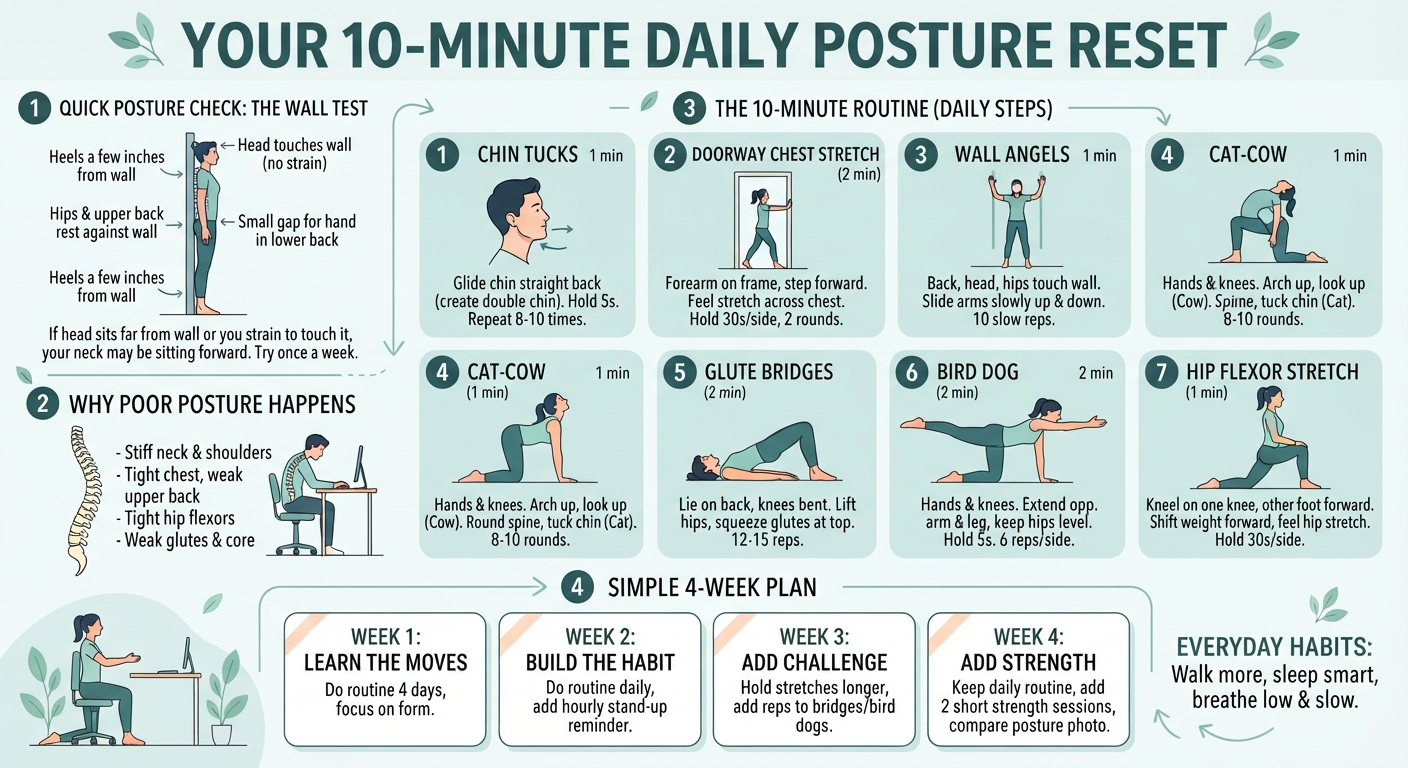
Think about the last time you checked how you were sitting. Not the chair or the screen, but your own body. There is a good chance your head was pushed forward, your shoulders were rolled in, and your lower back was sagging into the seat.
You are not alone. Long hours at desks, on sofas, in cars and over phones have turned slouching into the default setting for millions of people.
The good news is simple. You do not need an expensive gadget, a gym membership or a two-hour routine. A short daily habit, done with patience, can change how your body feels and how you carry yourself.
In this guide, you will learn:
- How to spot the early signs that your posture is slipping
- What research really says about posture and back pain
- A 10-minute routine you can do at home with no equipment
- Easy desk and phone habits that protect your progress
- When it is time to see a professional
Ready to improve your posture? Let us begin with the basics.
So, What Exactly Is Good Posture?
Posture is simply the way you hold your body while sitting, standing, walking or lying down. Good posture means your bones and joints are stacked in a balanced way, so your muscles do not have to work overtime just to keep you upright.
Imagine a straight line running down the side of your body when you stand. Ideally, it passes through your ear, shoulder, hip, knee and ankle. Here is a quick checklist:
- Ears stacked over your shoulders
- Shoulders relaxed, not hunched or dragged forward
- Ribs stacked over your pelvis, with no big arch in the lower back
- Knees soft, never locked
- Weight spread evenly across both feet
Notice what is missing from that list: stiffness. Good posture is not a rigid military stance. It should feel easy. If holding yourself up feels like a full-time job, you are trying too hard.
6 Signs Your Body Is Begging for a Posture Reset
Bad habits rarely announce themselves. They creep in quietly, one slouched afternoon at a time. Here are six signs your body may need some attention.
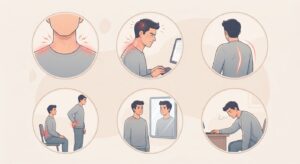
1. Your neck and shoulders feel tight by afternoon
When your head drifts forward, the muscles at the back of your neck work harder to hold it up. By mid-afternoon, that extra effort shows up as stiffness.
2. Tension headaches show up after screen time
Tight muscles at the neck and upper back can contribute to headaches at the base of the skull. Not every headache is caused by your posture, but if yours arrive after long hours at a desk, pay attention.
3. Your upper back looks rounded
A more curved upper back, with shoulders sitting forward, is common in people who spend hours hunched over keyboards and phones. Rounded shoulders are one of the most visible signs of slumped posture.
4. Your lower back aches after sitting
Sitting for long stretches, especially slumped, can leave the lower back sore the moment you stand up.
5. One shoulder sits higher than the other
Carrying a heavy bag on one side or leaning on one arm can create small imbalances over time. A slight difference is normal, so do not panic over a mirror check.
6. You feel tired for no clear reason
Holding an awkward position takes muscular effort, and a collapsed chest can make deep breathing feel harder. Many people feel more drained on days they slump for hours.
Ticked two or more? You are in good company, and this guide was written for you.
The 30-Second Wall Test You Can Try Right Now
Want a quick reality check? Try this.
Stand with your heels a few inches from a wall. Let your hips and upper back rest against it. Now see whether the back of your head can touch the wall without lifting your chin.
If your head sits far from the wall, or you have to strain to reach it, your neck may be sitting forward more than you think. Your lower back should leave a small gap, roughly the thickness of your hand. A gap much bigger or smaller than that is worth noticing.
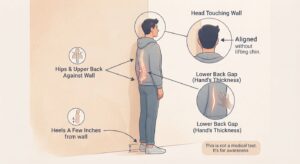
This is not a medical test. It is simply a handy way to become aware of your posture. Repeat it once a week and see how it changes.
What Poor Posture Does Behind the Scenes
Your spine has natural curves. They work a bit like a spring, absorbing shock and sharing the load across your back. When you slump for hours, those curves can flatten or exaggerate, and certain muscles and joints end up carrying more stress than they were built for.
Your head is also heavier than most people realize. An adult head weighs roughly 10 to 12 pounds, about 4.5 to 5.5 kilograms. When it sits right over your spine, your neck muscles cope well. When it drifts forward, they must work much harder to stop it from dropping.
Think of holding a bowling ball close to your chest versus at arm’s length. Same ball, very different effort.
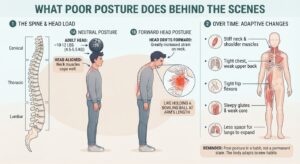
Over time, long periods of slumping can lead to:
- Stiff, overworked neck and shoulder muscles
- A tight chest paired with a weak upper back
- Tight hip flexors from too much sitting
- Sleepy glute muscles and a weak core
- Less space for your lungs to expand fully
Poor posture is a habit, not a life sentence. None of this happens overnight, and none of it is permanent. The body adapts to what you ask of it, and that works in your favor once you start asking for better things.
Why Standing Tall Pays You Back
Good posture will not cure everything, but good habits are not only about avoiding aches. Health organizations note that sitting and standing well can help keep your bones and joints aligned, reduce wear on joint surfaces, lower the strain on muscles and ligaments, and support easier breathing.
There is a mood angle too. Many people say they simply feel more alert and confident when they carry themselves openly. Science on that is still developing, so treat it as a pleasant bonus rather than a guarantee. Even so, a body that feels comfortable is a body that lets you focus on your day.
Let Us Bust a Few Myths (Because Facts Matter)
Before jumping into exercises, let us be honest about what science does and does not say. A lot of posture advice online is exaggerated, and you deserve the real picture.
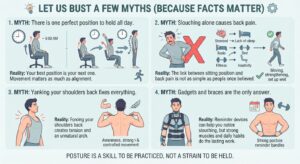
Myth: There is one perfect position to hold all day.
Reality: Your best position is your next one. Movement matters as much as alignment. Sitting perfectly upright for eight hours without moving is not the goal.
Myth: Slouching alone causes back pain.
Reality: The link between sitting position and back pain is not as simple as people once believed. Studies show mixed results, and pain has many contributors, including stress, poor sleep, low fitness and too much inactivity. Still, many people with back and neck discomfort feel better when they strengthen key muscles, move more often and set up their workspace well.
Myth: Yanking your shoulders back fixes everything.
Reality: Forcing your shoulders back creates tension and an unnatural arch. Lasting change in your posture comes from strength, flexibility and awareness, not from holding a strained position.
Myth: Gadgets and braces are the only answer.
Reality: Reminder devices can help you notice slouching, but strong muscles and daily habits do the lasting work.
That is why the routine below focuses on strength, mobility and movement rather than rigid rules. If you would like to read more about the basics, Harvard Health has a helpful overview here: https://www.health.harvard.edu/staying-healthy/why-good-posture-matters
Why 10 Minutes Beats a Marathon Workout
Consistency beats intensity every time. A short daily routine is far easier to keep than an hour-long session you skip three days a week. Ten minutes is short enough to fit before a shower, right after waking up or during a work break.
Think of it like brushing your teeth. No single brushing gives you healthy teeth, but the daily habit does. In the same way, small daily movements teach your muscles and joints new default positions. Ten minutes is a realistic posture habit even for busy people. Over a few weeks, better posture starts to feel natural instead of forced.
Here is what the routine is designed to do:
- Loosen the tight areas: chest, hip flexors and neck
- Strengthen the weak areas: upper back, glutes and core
- Build body awareness so you catch slouching sooner
The 10-Minute Routine, Step by Step
Set a timer, wear comfortable clothes and move slowly. Never push through sharp pain. A mild stretching sensation is fine, but pain is a signal to stop.
Step 1: Chin tucks (1 minute)
Sit or stand tall. Gently glide your chin straight back, as if making a double chin, without tilting your head down. Hold for 5 seconds, relax, and repeat 8 to 10 times.
Why it helps: It strengthens the deep muscles at the front of your neck and counters the forward head position.
Step 2: Doorway chest stretch (2 minutes)
Stand in a doorway with your forearm on the frame and your elbow near shoulder height. Step forward gently until you feel a stretch across your chest. Hold for 30 seconds on each side, and do two rounds.
Why it helps: Typing and driving tighten the chest muscles, which pull the shoulders forward.
Step 3: Wall angels (1 minute)
Stand with your back, head and hips lightly touching a wall, feet a few inches away. Bring your arms up into a goalpost shape and slide them slowly up and down, keeping contact with the wall as best you can. Do 10 slow reps.
Why it helps: It trains the muscles around your shoulder blades and improves upper back movement. It is harder than it looks, so go easy.
Step 4: Cat-cow (1 minute)
Get on your hands and knees. Slowly arch your back and look up, then round your spine and tuck your chin. Move with your breath for 8 to 10 rounds.
Why it helps: It wakes up the spine and loosens stiffness from sitting.
Step 5: Glute bridges (2 minutes)
Lie on your back with knees bent and feet flat. Press through your heels, lift your hips and squeeze your glutes at the top. Hold for 2 seconds, lower slowly, and do 12 to 15 reps.
Why it helps: Long sitting can leave the glutes underused. Strong glutes support your pelvis and lower back.
Step 6: Bird dog (2 minutes)
Start on hands and knees. Reach one arm forward and the opposite leg back, keeping your hips level. Hold for 5 seconds, switch sides, and do 6 reps per side.
Why it helps: It builds core stability, which helps you hold good posture with less effort.
Step 7: Hip flexor stretch (1 minute)
Kneel on one knee with the other foot in front. Tuck your pelvis slightly and shift forward until you feel a stretch at the front of the back hip. Hold for 30 seconds per side.
Why it helps: Tight hip flexors can tug on the pelvis and add to lower back strain.
Make It Stick
- Do it at the same time every day, such as right after brushing your teeth
- Keep a yoga mat where you can see it
- Tick off each day on a calendar, because a small win feels surprisingly good
- Start with fewer reps if you are new, and add more each week
Fix Your Desk, Fix Your Day
Your routine only works if your daily setup does not undo it. Good posture at your desk is mostly about setup, not willpower. A few small tweaks make a big difference:
- Place the top of your screen at or slightly below eye level, about an arm’s length away
- Keep your feet flat on the floor or on a footrest
- Keep your knees at roughly hip height
- Bend your elbows to about 90 degrees, close to your body
- Support your lower back with the chair’s curve or a small cushion
- Stand up and move at least once every hour
That last one is the most important. The best chair in the world becomes a problem if you never leave it. Set a gentle timer, walk to refill your water, stretch your arms overhead, or take phone calls on your feet.
If you use a laptop, raise it on a stand or a stack of books and use a separate keyboard. A laptop flat on the desk pulls your head down and your shoulders forward almost by design.
Phone Neck: The Habit Nobody Admits To
Be honest: how many times did you look down at your phone today? Looking down for long periods puts extra load on your neck and upper back. One widely cited estimate suggests the strain rises sharply as your head tilts further forward, though exact numbers differ from person to person.
Try these simple fixes:
- Raise the phone closer to eye level instead of lowering your head
- Rest your elbow against your body for support
- Use voice messages or speech to text for long replies
- Take a short break after every 20 to 30 minutes of scrolling
Since most of us pick up our phones dozens of times a day, even a small adjustment improves your posture across the whole day.
Everyday Habits That Keep Results Alive
The 10-minute routine does the heavy lifting, but these habits keep your progress going:
- Walk more. Even short walks after meals help your joints and muscles stay mobile.
- Alternate your bag side. Or use a backpack with both straps on your shoulders.
- Sleep smart. A pillow that keeps your neck in line with your spine helps you wake up with fewer aches.
- Strength train twice a week. Rows, squats and deadlifts build the muscles that support your posture and your frame. Get guidance on form if you are new.
- Breathe low and slow. Deep belly breathing relaxes tight neck and shoulder muscles.
- Check in three times a day. Ask yourself where your shoulders, jaw and feet are. Adjust gently and carry on.
Think of posture as a skill, not a fixed trait. Skills improve with practice, and you are allowed to be a beginner.
Your 60-Second Desk Reset
Some days are packed, and the full routine simply will not happen. On those days, borrow this mini version:
- Roll your shoulders back and down three times
- Do five chin tucks
- Clasp your hands behind your back and gently lift for 15 seconds
- Stand up, reach overhead and take two deep breaths
It is not a replacement for your daily habit, but it keeps the momentum alive.
Your Simple 4-Week Plan
Not sure how to begin? Follow this gentle roadmap.
Week 1: Learn the moves. Do the routine four days this week. Go slowly, focus on form, and skip anything that hurts.
Week 2: Build the daily habit. Do all seven steps every day. Add a reminder to stand up each hour at work.
Week 3: Add a little challenge. Hold stretches a bit longer and add a few reps to bridges and bird dogs. Fix your desk setup if you have not yet.
Week 4: Add strength. Keep the daily routine and add two short strength sessions. If you like, take a side photo of your natural standing posture and compare it with Week 1.
Most people notice their body feels looser within a couple of weeks, though everyone is different. Be patient. Lasting change takes weeks, not days.
When to See a Professional
This guide is general information, not medical advice. Some symptoms need a professional, not a stretching routine. See a doctor or physiotherapist if you notice:
- Numbness, tingling or weakness in your arms or legs
- Back pain after a fall or injury
- Pain that wakes you at night or does not improve after a few weeks
- Fever or unexplained weight loss along with back pain
- Loss of bladder or bowel control (seek urgent care)

A qualified professional can assess your posture, find the real cause and build a plan for your body. If you have a spinal condition, check with them before starting new exercises.
Final Thoughts: Stand Tall, Live Better
Your body is not broken, and your posture is not fixed. It has simply been adapting to long hours in the same shapes. The habits that got you here can be replaced by better ones.
Remember the big ideas:
- Good posture is relaxed, balanced and mobile, not stiff
- Movement matters as much as position
- Ten focused minutes a day beat occasional long sessions
- Small changes at your desk and phone protect your progress
- Patience and consistency win
Start today. Set a timer, do Step 1, and promise yourself you will do it again tomorrow. Better posture is built one small, calm day at a time. Your back will thank you, and so will the future you.