
You have made up your mind. You want to buy your first crypto token. Maybe a friend has been talking about it for weeks, or maybe you simply got tired of watching from the sidelines.
Then comes the first real question. Where do you actually buy it?
One person tells you to use a big exchange like Binance or Coinbase. Another says real crypto users only trade on Uniswap. A third warns you not to trust anyone with your money. Suddenly a simple purchase feels like a maze.
That maze has a name: DEX vs CEX.
In this guide, I will walk you through the DEX vs CEX debate in plain language, with no jargon walls and no hype. By the end, you will know which door suits you best.
Why Your First Trade Matters More Than You Think
Your first trade sets the tone for everything that follows. A smooth start builds confidence. A messy start, like sending coins to the wrong address or paying a fee you did not expect, can scare people away from crypto for good.
Here is the part most beginners miss. The platform you choose decides three big things:
- Who controls your money while you trade
- How much personal information you hand over
- What can go wrong, and who can help you when it does
None of these are small details. They are the foundation of the DEX vs CEX choice.

So let’s start with the basics.
What Is a CEX? Think of It as a Crypto Supermarket
CEX stands for centralized exchange. Binance, Coinbase and Kraken are well known examples.
Picture a supermarket. The shelves are organized, the staff wears uniforms, and there is a help desk near the entrance. You walk in, pick what you want, pay, and walk out. Someone else manages the warehouse.
A CEX works in a similar way. A company runs the platform, matches buyers with sellers, and keeps your coins in its own wallets while they sit in your account. You log in with an email and password, just like any other app.
You can usually pay with a bank transfer or a card, which makes it the easiest bridge between normal money and crypto. That convenience is the main reason most beginners start here.
The catch is trust. When you use a CEX, you trust the company to stay honest, stay secure and stay open for business. Remember this point, because it comes back again and again in the DEX vs CEX comparison.
What Is a DEX? Think of It as an Open Market Square
DEX stands for decentralized exchange. Uniswap, PancakeSwap and SushiSwap are popular examples, and Uniswap has been around since 2018.
Now picture an open market square with no owner. Anyone can set up a stall, and the rules are written in public. Nobody checks your name at the gate. You trade directly, and you carry your own bag home.
A DEX runs on smart contracts, which are small programs on a blockchain that carry out trades automatically. Most popular DEXs use something called an automated market maker. Instead of matching you with another person, you swap against a pool of tokens that other users have deposited. The price adjusts by a formula as the pool changes.
To use a DEX, you connect a crypto wallet such as MetaMask or Trust Wallet. Your coins stay in that wallet. The DEX never takes custody of them.

Freedom sounds wonderful, and it is. But freedom also means the responsibility is yours. That trade off sits at the heart of DEX vs CEX.
The DEX vs CEX Showdown: 8 Differences That Actually Matter
Enough theory. Here are the eight differences that will shape your first trade. Read them slowly, because each one can save you money or stress.
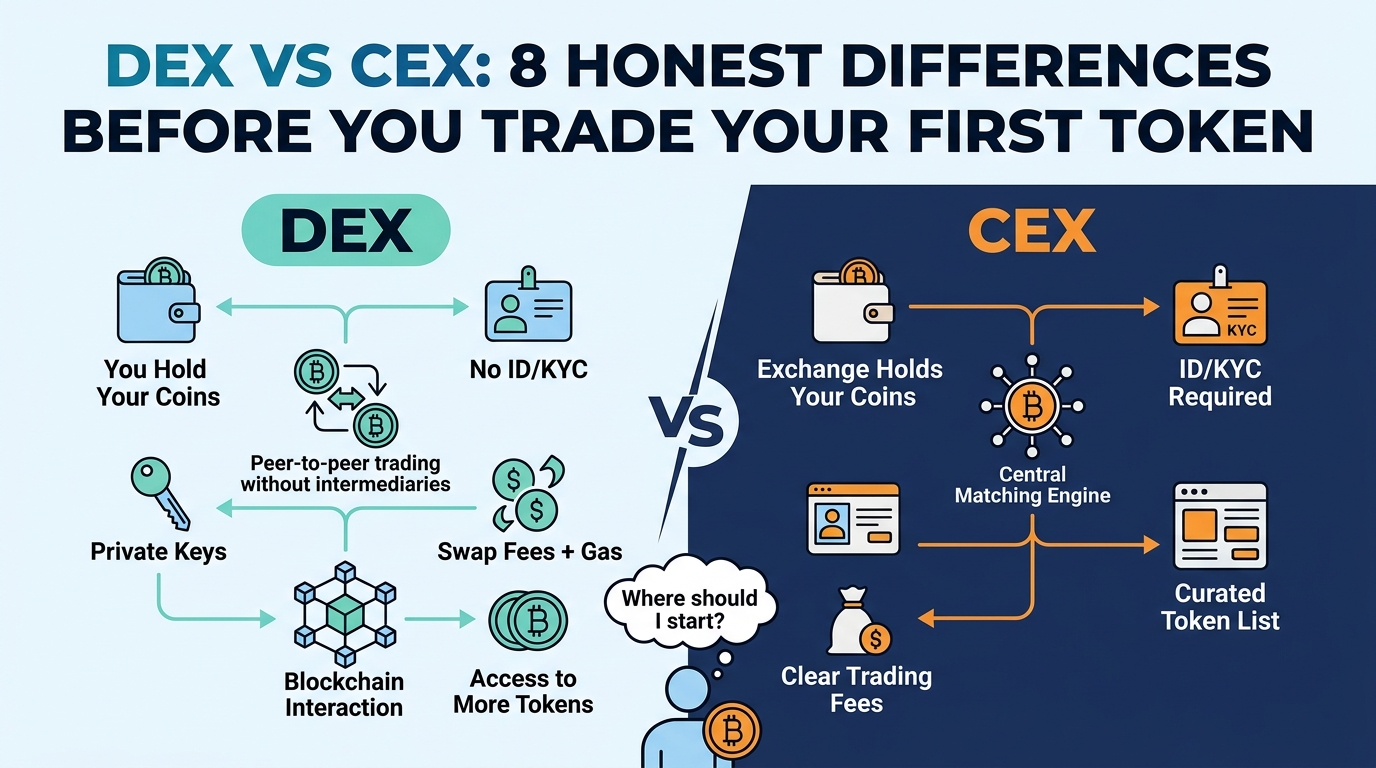
1. Who Really Holds Your Coins?
On a CEX, the exchange holds your coins. Your account shows a balance, but technically that balance is a promise from the company. You can only withdraw if the exchange allows it.
On a DEX, you keep your coins in your own wallet at all times. You sign each trade yourself.
Why does this matter? Because exchanges can fail. In November 2022, the exchange FTX collapsed and many customers could not get their money out. That event taught the whole industry a hard lesson about custody.
Crypto has a popular saying for this: not your keys, not your coins. It is a simple way to remember the biggest custody difference in DEX vs CEX.
2. Do You Need to Show Your ID?
Most centralized exchanges ask you to verify your identity. You upload an ID, maybe a selfie, and wait for approval. This process is called KYC, short for know your customer.
A DEX usually asks for none of that. You connect a wallet and start trading.
Be careful with the word “private” though. DEX trades happen on a public blockchain, so anyone can look at your wallet activity. You are not hidden. You are simply not registered with a company.
For privacy lovers, this is a major point in the DEX vs CEX discussion. For people who like a regulated setup, KYC is actually a comfort.
3. The Fees Nobody Explains Properly
Fees confuse beginners more than anything else.
A CEX usually charges a trading fee, often a small percentage of each trade. It may also charge a withdrawal fee when you move coins out.
A DEX works differently. You pay a swap fee that goes to the liquidity providers, and you also pay a network fee, often called a gas fee, to the blockchain itself. On Ethereum, gas fees go up when the network is busy. Cheaper networks and layer 2 chains can reduce this cost.
Here is a simple way to think about it:
- CEX: fees are usually listed clearly before you confirm
- DEX: network fees can change from minute to minute
So when someone says one is cheaper, ask which network, which token and what time of day. Fees alone rarely settle DEX vs CEX.
4. Speed, Liquidity and Slippage
Liquidity means how easily you can buy or sell without moving the price. Big centralized exchanges usually have deep liquidity for popular coins, so your order tends to fill quickly at a fair price.
On a DEX, liquidity depends on the pool. A busy pool is fine. A small pool can cause slippage, which means you get a worse price than the one you saw when you clicked the button.
Let me make it real. Imagine you try to buy a small, unknown token whose pool holds only a modest amount of money. Your own order could push the price noticeably. That is slippage in action.
Most DEX screens let you set a slippage limit. Beginners should keep it low and learn what it does before trading anything exotic. On the big networks, popular tokens often trade smoothly on both sides, so the liquidity gap in DEX vs CEX matters most for smaller, newer tokens.
Before we move on, here is one line worth remembering. The Ethereum website explains that a DEX lets you trade digital assets without giving a centralized company control of your funds (source: ethereum.org). That single idea sums up the whole DEX vs CEX debate better than a long essay.
5. Which Tokens Can You Trade?
A CEX lists tokens after reviewing them. That process is not perfect, but it filters out many obvious junk projects. You see a limited, curated menu.
A DEX is open. Anyone can create a token and make a trading pool for it. That is why brand new tokens often appear on a DEX first.
It is also why scam tokens appear there. Fake coins with copied names are common. Always check the official contract address from the project’s own website before you swap.
If you enjoy early discoveries, a DEX gives you access. If you want a safer, shorter menu, a CEX feels calmer. This is one of the clearest lines in DEX vs CEX.
6. Where Each One Can Hurt You
No platform is risk free. They are just risky in different ways.
With a CEX, the main dangers are:
- Exchange hacks or insolvency
- Frozen accounts or paused withdrawals
- Stolen passwords through phishing
With a DEX, the main dangers are:
- Smart contract bugs that hackers exploit
- Fake tokens and rug pulls
- Approving a malicious contract by mistake
- Losing your seed phrase, which no one can reset for you
Notice the pattern. On a CEX, the company’s mistakes can hurt you. On a DEX, your own mistakes can hurt you, and there is no help desk to reverse them.
Both are manageable. Use two factor authentication on every account, double check every address, and never share your seed phrase. Safety habits matter more than the DEX vs CEX label.
7. Ease of Use and Support When Things Go Wrong
Here the CEX wins for beginners, and it is not close. The app looks familiar, you can reset a forgotten password, and you can chat with support if a deposit goes missing.
A DEX asks you to learn new things: wallets, networks, gas, approvals. If you send tokens on the wrong network, there may be nobody to call. Blockchain transactions are final.
That does not mean a DEX is too hard. It means you should practice with a tiny amount first. Many people get comfortable after a handful of small swaps.
Ease of use is the part of DEX vs CEX where beginners should be most honest with themselves.
8. Rules, Regulation and Local Laws
Centralized exchanges are usually registered businesses, and in many countries they follow financial regulations. That often means KYC checks and reporting duties.
DEXs sit in a more complicated space, because no single company controls them. Regulators around the world are still working out how to handle them, so the rules keep changing.
Whichever side you pick, your local laws still apply to you. Crypto rules differ from country to country, including on taxes. Check what your country allows before you trade, and keep records of your transactions.
Regulation is a moving target, so treat it as part of your homework in any DEX vs CEX decision.
Side by Side Snapshot
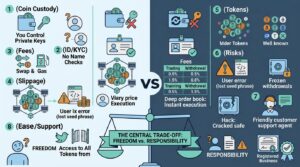
Here is the whole story in eight quick lines:
- Custody: a CEX holds your coins, a DEX leaves them with you
- Sign up: a CEX usually needs KYC, a DEX needs a wallet
- Fees: a CEX charges trading fees, a DEX charges swap fees plus gas
- Liquidity: a CEX is usually deeper, a DEX depends on the pool
- Tokens: a CEX is curated, a DEX is open to everyone
- Main risk: company failure on a CEX, smart contract bugs and user error on a DEX
- Support: a CEX has a help desk, a DEX does not
- Rules: a CEX is a regulated business, a DEX sits in evolving territory
Save this list somewhere. It is your DEX vs CEX cheat sheet.
DEX vs CEX: Which One Fits You?
The honest answer is that it depends on you.
A CEX may suit you if:
- You are completely new to crypto
- You want to pay with a bank transfer or card
- You value customer support
- You prefer a simple, familiar app
A DEX may suit you if:
- You already own a wallet and understand your seed phrase
- You want full control of your coins
- You want access to newer tokens
- You are comfortable with a few extra steps
Many people ask me for one winner. There isn’t one. The better choice in DEX vs CEX is the one that matches your experience level today, not your ambition for next year.
Your First Trade on a CEX, Step by Step
If you decide to start with a CEX, keep it simple:
- Pick a well known exchange that is available in your country
- Create your account and turn on two factor authentication straight away
- Complete the identity check
- Deposit a small amount
- Buy a small amount of the token you want
- Think about moving long term holdings to a wallet you control
Still undecided in the DEX vs CEX race? This route is the gentlest start.

Your First Trade on a DEX, Step by Step
If you are ready for a DEX, slow and careful wins:
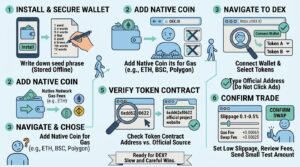
- Install a well known wallet and write your seed phrase on paper, stored offline
- Add the network’s native coin to the wallet, for example ETH for Ethereum, often bought first on a CEX
- Open the DEX by typing the official address yourself, not by clicking an ad
- Connect your wallet and choose the tokens
- Check the token’s contract address against the project’s official site
- Set a low slippage limit, review the fees and confirm
Send a small test amount first. It is a habit every careful trader keeps, whatever side of DEX vs CEX they prefer.
Two Friends, Two Different Paths
Imagine two friends, Sara and Bilal. Both want to buy the same token on the same day.
Sara opens a CEX app. She verifies her ID, pays by bank transfer and buys the token in a few taps. The approval takes a little time, but after that everything feels smooth. If she forgets her password, support helps her reset it.
Bilal goes to a DEX. He installs a wallet, writes down his seed phrase and buys some ETH first. Then he connects to the exchange, checks the token’s contract address and swaps. He pays a network fee, but nobody asked for his ID and his coins never left his wallet.
Both reached the same token. Sara chose comfort, and Bilal chose control. Neither is wrong, and that is why the DEX vs CEX question has no single answer.
So if a friend asks which one is better, the best reply is another question: better for whom?
Five Beginner Mistakes to Avoid
Almost every horror story in DEX vs CEX begins with one of these:
- Chasing a token only because social media is shouting about it
- Clicking sponsored search results that lead to fake DEX websites
- Sending coins on the wrong network
- Sharing a seed phrase with anyone, even someone who sounds helpful
- Trading money you cannot afford to lose
Slow down. In crypto, patience is a skill, and it pays.
Two Myths That Confuse Everyone
Myth one: a DEX is always safer because nobody holds your coins. Not true. Smart contract bugs and fake tokens are real dangers, and a single wrong approval can empty a wallet.
Myth two: a CEX is always safer because it is a big company. Also not true. Size does not guarantee honesty, and FTX proved it.
The truth sits in the middle. Neither side is magic. Your habits are the real security system, and that is the lesson that matters most in DEX vs CEX.

The Smart Middle Path in the DEX vs CEX Debate
Plenty of experienced traders do not pick a side at all. They use both.
A common routine looks like this:
- Use a CEX to turn local money into crypto
- Move long term holdings into a wallet they control
- Use a DEX only for tokens that are not listed on a CEX
- Keep trading amounts small on anything new
Seen this way, DEX vs CEX is less a battle and more a toolbox. You use the right tool for the job.
Quick Questions Beginners Ask
Can I use both a CEX and a DEX?
Yes. Many people do. Using both is a practical answer to the DEX vs CEX question.
Is a DEX anonymous?
Not really. It does not ask for your name, but every trade is recorded on a public blockchain.
Which one has lower fees?
It depends on the network, the token and the time. Compare the full cost before you confirm, including gas on a DEX.
Do I need a lot of money to start?
No. Begin with a small amount you can afford to lose while you learn how DEX vs CEX platforms behave in real life.
Final Thoughts: Your First Token, Your Rules
Nobody wins the DEX vs CEX argument for everyone. A CEX gives you comfort, support and a familiar feel. A DEX gives you freedom, control and open access, with the responsibility that comes with it.
If you are brand new, start small on a CEX and learn the language of crypto. When you feel ready, try a DEX with a tiny test amount and grow your confidence step by step. That is how most people build real skill.
Whatever you choose in the DEX vs CEX decision, protect your keys, double check every address and never trade money you cannot afford to lose.
This article is for education only and is not financial advice. Do your own research before you trade.