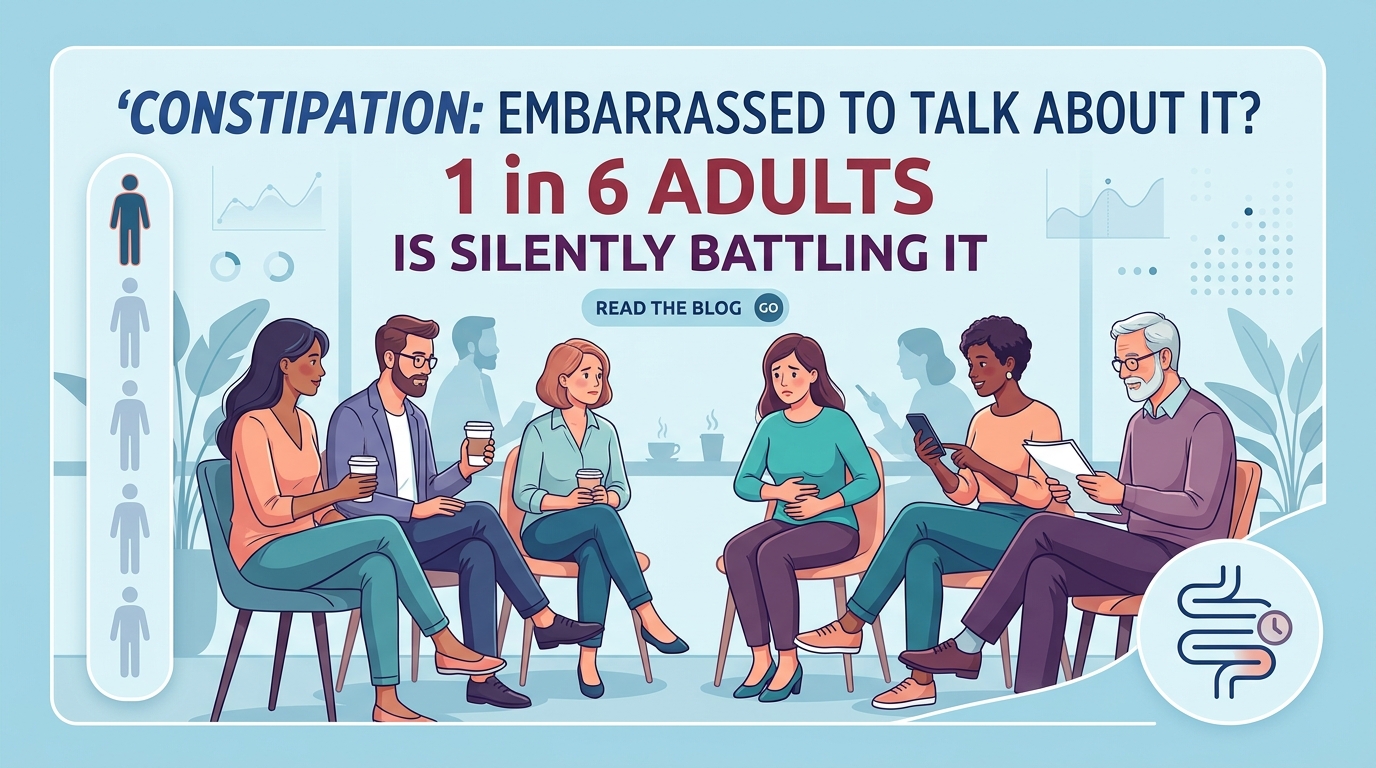
Let us be honest. Nobody leans across the dinner table and announces that they have not had a proper bowel movement in four days. We talk about headaches, back pain and sleepless nights, but this subject usually earns an awkward smile and a very quick change of topic.
That silence is the real problem. Constipation is one of the most common digestive complaints in the world, yet many people deal with it alone, trying one home trick after another and hoping it goes away.
Research suggests that somewhere around 14 to 16 percent of adults are affected, which is roughly one in six people, although the exact figure varies between countries and age groups. It is also reported more often in women and in older adults.
So if you are reading this with a heavy, bloated stomach, you are far from alone. This blog explains what constipation really is, why it happens, which signs deserve your attention and what you can do about it starting today. Think of it as a friendly chat with someone who is not embarrassed in the least.
Why We Feel So Shy About This Subject
Toilet talk is taboo in most cultures. We learn early that bodily functions are private, so we grow up feeling that any problem down there is something to hide. The result is that people wait months, sometimes years, before mentioning constipation to anyone.
Waiting has a cost. The longer a problem continues, the harder it can be to fix, and some serious conditions are found late because someone was too embarrassed to ask.

Here is a comforting thought. Doctors and pharmacists deal with bowel complaints every single day. To them, your question is routine. Talking about constipation early is not oversharing. It is simply good self care.
What Exactly Are We Talking About?
Many people assume constipation simply means not going every day. The truth is a little more flexible than that.
Doctors usually describe it as having fewer than three bowel movements in a week, along with stools that are hard, dry or difficult to pass. But the number is only part of the picture. Plenty of people go daily and still feel stuck, because comfort matters as much as frequency.
Here is what often goes along with it:
- Straining or pushing hard to pass stool
- Stools that look lumpy or like small pellets
- A feeling that the bowel has not emptied fully
- A sense that something is blocking the way out
- Needing extra help, such as pressing around the area, to get stool out
Constipation is often called acute when it lasts a short time and chronic when it keeps coming back over several months. Short spells are very common and usually settle with simple changes. Long lasting constipation deserves a closer look.
Is Your “Normal” Really Normal?
Bowel habits are personal. Some healthy people go three times a day, others every second day, and both can be perfectly fine.
What matters is a change from your own usual pattern. If things used to run smoothly and now feel stuck, that shift is worth noticing.
Doctors often use a chart called the Bristol Stool Scale to describe stool shape. Types 1 and 2, which look like separate hard lumps or a lumpy sausage, point toward constipation. Types 3 and 4 are smoother and softer, and are generally considered healthy.
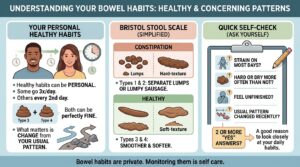
Try this quick self check:
- Do you strain on most days?
- Are your stools hard or dry more often than not?
- Do you feel unfinished after you go?
- Has your usual pattern changed recently?
Two or more yes answers are a good reason to look closely at your daily habits.
6 Signs Your Body Is Quietly Warning You About Constipation
Not every sign is dramatic. Some are subtle and easy to blame on something else. Watch for these six.
1. Fewer trips than usual. Going less than three times a week is the classic marker, especially if it is a new pattern for you.
2. Hard, dry or pellet like stools. When stool sits in the colon too long, it loses water and becomes tough to pass.
3. Straining and discomfort. If you spend long minutes pushing and come away sore, your body is complaining.
4. A bloated, swollen belly. Stool that stays too long gives gas more time to build up, so your stomach may feel tight and full.
5. Cramps or lower belly pain. A dull ache or cramping is common, and it often eases a little after you finally go.
6. That unfinished feeling. Even after a visit to the toilet, it seems like something is left behind.
Some people also lose their appetite or feel sluggish and low on energy when constipation lingers. That is understandable, since an overloaded gut rarely makes anyone feel light and fresh.
Why Your Gut Slows Down: The Usual Suspects
There is rarely one single cause. More often, a few small things pile up until your digestion stops cooperating.
- Low fiber meals. Fewer vegetables, fruits, pulses and whole grains means less bulk and softness in stool.
- Not enough fluids. The body takes water from where it needs it most, and the colon is not first in line.
- Too little movement. Long hours of sitting can make the gut sluggish.
- Ignoring the urge. Holding it in again and again dulls the signal over time.
- Routine changes. Travel, stress, shift work and irregular meals can all throw the system off.
- Hormonal shifts. Pregnancy is a well known example.
- Age. Gut muscles can become less active as we get older.
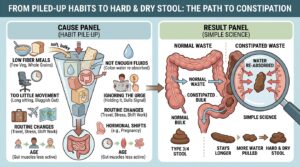
Here is the simple science. Your colon absorbs water from waste as it passes through. The longer waste stays there, the more water is pulled out, and the harder and drier it becomes. That is the basic story behind most everyday constipation.
The Fiber Gap: How Your Plate Can Cause or Cure Constipation
Fiber is the part of plant food that your body cannot fully digest, and that is exactly why it helps. It adds bulk and softness, which makes stool easier to move along.
There are two main types:
- Soluble fiber dissolves into a soft gel. Oats, beans, lentils, apples and citrus fruits are good sources.
- Insoluble fiber adds bulk. Whole grains, nuts and the skins of many vegetables provide it.
Most adults are advised to aim for roughly 25 to 35 grams of fiber a day, and a lot of us fall short, especially when meals are built around white bread, fried snacks, processed food and plenty of cheese or meat.
The National Institute of Diabetes and Digestive and Kidney Diseases lists low fiber intake, too little fluid and certain medicines among the common contributors to constipation (NIDDK).
A few friendly foods to try:
- Prunes, which have been studied for easing constipation and are gentle for most people
- Kiwi fruit, which also has research behind it
- Pears, apples and berries
- Oats, lentils and chickpeas
- Chia and ground flaxseed, with plenty of water
- Leafy greens and other vegetables
One important warning. Raise your fiber slowly over a couple of weeks. A sudden jump can bring gas, cramps and even more bloating. Also drink more water as fiber goes up, because fiber without enough fluid can make things worse.
The Water Question
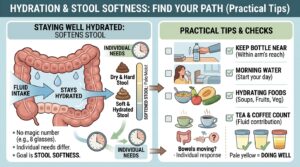
You have probably heard “drink eight glasses a day.” There is no magic number that suits everyone, but staying well hydrated clearly helps stool stay soft.
Practical ways to get more fluid:
- Keep a bottle within arm’s reach
- Start your morning with a glass of water
- Add soups, fresh fruit and watery vegetables to your meals
- Check your urine color, since pale yellow usually means you are doing well
Tea and coffee count toward fluids too, though some people find that coffee gets their bowels moving while others notice nothing.
Medicines and Health Conditions Hiding in the Background
Sometimes the cause is not your plate at all. Several common medicines can slow the gut:
- Strong painkillers such as opioids
- Iron supplements
- Some antacids containing calcium or aluminum
- Certain antidepressants
- Some blood pressure and allergy medicines
Please do not stop a prescribed medicine on your own. Speak with your doctor, who may change the dose or suggest a helpful add on.
Certain health conditions can also play a role, including an underactive thyroid, diabetes, irritable bowel syndrome, Parkinson’s disease, spinal cord problems and pelvic floor muscle problems. When constipation does not respond to simple lifestyle changes, a hidden cause is worth looking for.
The Small Habit That Quietly Makes Everything Worse
Here is a confession many of us can relate to. We are busy, the toilet is not convenient, and the urge gets postponed. Then it gets postponed again.
Over time, the body learns to ignore the signal. Stool stays longer, grows harder and becomes tougher to pass. It turns into a cycle that feeds itself, and constipation settles in.
Better habits:
- Go when your body signals, not when it is convenient
- Do not rush. Give yourself a few calm minutes
- Skip the long phone scroll on the toilet, since sitting for ages adds pressure on the area
- Do not strain hard, because pushing too much can lead to hemorrhoids
Gentle Fixes You Can Start Today
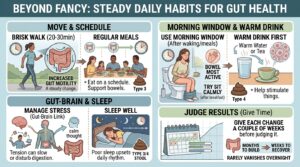
You rarely need anything fancy. A few steady changes usually bring the biggest results.
- Move your body. A brisk 20 to 30 minute walk can get the gut going.
- Use your morning window. The bowel is often most active after waking and after meals, so try sitting calmly after breakfast.
- Warm drink first thing. Warm water or tea can help stimulate things for some people.
- Eat on a schedule. Regular meals support regular bowels.
- Manage stress. The gut and brain are closely linked, and tension can slow or disturb digestion.
- Sleep well. Poor sleep often upsets the daily rhythm of the body.
Give each change a couple of weeks before judging it. Constipation that built up over months rarely vanishes overnight.
A Sample Day for a Happier Gut
Sometimes it helps to see how this looks in real life. Here is one simple example:
- Morning: A glass of water, then oats topped with a chopped pear or a few prunes
- Midday: A plate with lentils or chickpeas, vegetables and whole wheat bread, plus a short walk afterward
- Afternoon: A piece of fruit or a handful of nuts, and another glass or two of water
- Evening: A light dinner with plenty of vegetables, and some gentle movement
- Night: A calm wind down and enough sleep
Nothing here is extreme. It is just a pattern that gives your gut what it needs to keep moving.
The Footstool Trick Worth Trying
This one sounds almost too simple, but it makes sense. Sitting on a standard toilet keeps your knees at about hip level, and that position can leave a bend in the lower end of the bowel that makes passing stool harder.
Resting your feet on a small stool raises your knees above your hips, closer to a squat. Many people find it helps stool pass with less effort. Studies on this position suggest it can reduce straining, though results vary from person to person.
How to do it:
- Place a low stool, about 7 to 9 inches high, in front of the toilet
- Rest your feet on it and lean forward slightly
- Keep your elbows on your knees and relax your belly
- Breathe slowly instead of holding your breath and pushing
What About Laxatives?
Laxatives can be useful, but they work best as a short term helper, not a daily crutch. The main types are:
- Bulk forming (such as psyllium husk), which add bulk and soften stool. Drink plenty of water with them.
- Osmotic (such as polyethylene glycol), which draw water into the bowel.
- Stool softeners, which make stool easier to pass.
- Stimulant laxatives, which trigger the bowel muscles to move.
Stimulant types are meant for occasional use, since frequent use can make the bowel depend on them. If you find yourself reaching for any laxative week after week, it is time to talk to a doctor or pharmacist. Constipation that needs constant medicine is a sign that something underneath needs attention.
Kids, Pregnancy and Older Age: When the Gut Needs Extra Care
Different life stages bring different triggers for constipation.
Children. Kids sometimes hold back stool because they fear painful toilet visits or do not want to stop playing. This leads to hard stools, which hurt, which leads to more holding back. Fiber, fluids, relaxed toilet routines and patience help. Persistent constipation in a child should be checked by a pediatrician.
Pregnancy. Hormonal changes slow the gut, and the growing womb adds pressure. Iron supplements can contribute too. Always check with your doctor before using any remedy during pregnancy.
Older adults. Less movement, lower fluid intake and multiple medicines can all add up. Constipation in older adults should never be written off as “just age,” because it can sometimes point to something else.
When Constipation Deserves a Doctor’s Attention
Most cases are harmless and improve with small changes. Some are not. Please see a doctor if you notice:
- Blood in your stool or on toilet paper
- Black or tar like stools
- Severe or worsening belly pain
- Unexplained weight loss
- Constipation that begins suddenly and does not improve, especially after age 50
- A family history of bowel or colon cancer
- Constipation lasting for weeks despite lifestyle changes
- Vomiting, or a swollen belly with no gas passing
Go to emergency care if you have severe pain, repeated vomiting and cannot pass gas or stool at all.
There is no need to feel shy in the clinic. A short honest conversation can save weeks of discomfort. Your doctor may ask about your diet, medicines and routine, examine your abdomen, and sometimes suggest blood tests or other checks.
What Happens If You Keep Ignoring It?
Leaving constipation untreated is rarely dangerous for most people, but it can bring painful companions:
- Hemorrhoids. Swollen veins around the anus from straining
- Anal fissures. Small tears caused by passing hard stool
- Fecal impaction. A hard mass of stool stuck in the bowel that may need medical help to remove
- Constant discomfort. Bloating, appetite loss and a low mood
The earlier you act, the simpler the solution tends to be.
Myths That Keep People Stuck
- “You must go every single day.” Not true. Patterns vary from person to person.
- “Water alone will fix it.” It helps, but fiber and movement matter too.
- “Laxatives are harmless.” Overuse of some types can cause problems.
- “Constipation will sort itself out if I ignore it.” Sometimes it does, but often it does not.
Quick Answers to Questions People Ask in Whispers
Does missing one day mean I have a problem? Not at all. Look at your overall pattern, not a single day.
Can stress really affect my bowels? Yes. The gut and brain communicate constantly, and stress can speed up or slow down digestion.
Is coffee a good fix? For some people, a cup triggers the urge. It is not a reliable cure and does not replace fiber and water.
Can fiber supplements replace food? They can help, but whole foods bring extra nutrients. Start with a small dose and drink water.
Can constipation go away by itself? Short spells often do, especially after travel or a change in diet. If it lasts for weeks, get help.
Final Thoughts: Let Us Make This Topic Less Awkward
Constipation is not a personal failure, and it is nothing to hide. It is a common, treatable problem that responds well to patience and small, consistent changes.
Start with what is in your control: more fiber, enough water, daily movement, a calm toilet routine and listening when your body speaks. If those steps do not help, or if any red flag shows up, get professional advice without delay.
Remember the title of this blog. One in six adults is quietly dealing with constipation, which means someone in your family, friend circle or office is probably nodding along right now. Talking openly is the first step toward feeling better.
So share this with someone who needs it. It might just be the conversation that finally gets them unstuck.
This blog is for general awareness and is not a substitute for medical advice. Please consult a qualified doctor about your own health.